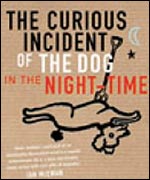
In a special edition from the Hay Festival, Newsnight Review discussed The Curious Incident of the Dog in the Night-Time by Mark Haddon.
(Edited highlights of the panel's review taken from the teletext subtitles that are generated live for Newsnight Review.)
GERMAINE GREER: I thought the book was wonderful. It's not because I think my mother has probably got Asperger's, and somebody finally told me how she thinks. I have spent 65 years trying to figure it out! Someone comes along and tells me that my mother's world makes perfect sense. His world makes sense. It's just not the same world as the world of other people. That means that, when he comes up against other people, they seem insane, and he seems sane. Their behaviour is outrageous, cruel, stupid, vulgar, because this child is so intelligent, so focused, so orderly. He is involved, like any subject people, in this attempt to make himself understood to other people. It's all on his side. Everybody deceives him, takes liberties with him, touches him when he can't bear to be touched. The curious thing is that it kind of intercepted with the James Frey book, because you realise that there is actually a lot more autism about than you might think, and we all have autistic traits. We could all recognise some of his little obsessional behaviours. We also know he is a person who is extremely vulnerable, and at the same time extremely dangerous. It's a book for children. It's a book for adults. It's a book for me, who spent 65 years with someone I couldn't understand. I think it's a staggering achievement, and it's beautifully, effortlessly, clearly, limpidly written. It doesn't strain after any effect.
RACHEL HOLMES:
It is suspenseful. Christopher is obsessed with Conan Doyle, so his interest in Sherlock Holmes is one of his obsessions. One of the things that makes it very interesting is that he believes that his detective knowledge is going to help him in a forensic scientific way, solve the mysteries around him of who put the pitch fork in the dog and the disappearance of his mother, and various other mysteries. He believes that it is that application that will reveal it. In the end, of course, it isn't just like in Conan Doyle's Sherlock Holmes. It's not the science and forensics that solve the problems but the way they become emotional traps and the way you get the confessions. But at the same time, I like this book, and Christopher is a very engaging character. But, for me, because he is typical. He is alienated. Teenagers don't like being touched. They are obsessive. Yes, he is different, but I also think that one needs to be careful that, just because he is good at maths and he is logical and he is accurate about grammar, that somehow this makes him an unusual...
KIRSTY WARK:
Hari, it's a great book where he is trying to make sense of things. He says, "I am in a special needs school, but everyone has special needs." There was a lot of humour, but not in a patronising way?
HARI KUNZRU:
That's the achievement of the book, that it presents the world from the point of view of this character. You are shown the world through his eyes and you learn a lot. That's a marvellous aspect of it. I am slightly less certain whether it's totally successful. He feels constructed to me, at times. There is a necessary simplicity about his language, and he is interested in facts. He is interested in greater clarity of statement. But at times, this seems to kind of dissipate the character into a kind of formalism which seems to be more to do with the writer's research about Asperger's syndrome.
BILL BUFORD:
I loved the book. It was one of the cleverest books I have read in a long time. Sure, there is a deceit. He is the genius spaz. On one level, he is completely arrested, and on the other level he is completely brilliant. It was working on two levels. He attacks metaphor. He describes metaphor as a way of describing something in terms which it isn't, so metaphor is basically a lie. It's raining cats and dogs, or you laughed your socks off. You are the apple of my eye. He wants to know where is the apple in the eye? That approach is in many ways a metaphor for the book. Here is someone saying why can't someone be honest. At the heart of the book is betrayal. His mother leaves his father. His father betrays him. He is simply saying, "Why can't you love me? Why can't you be straight?" I just thought it was terrific.
KIRSTY WARK:
This book is published in two editions, one for adults, one for kids. Nothing different except for the dust jacket. The rise of the cross-over book. Do you think it works as well for adults as it does for children?
GERMAINE GREER:
I only read books written for adults. I see children playing with toys. They are decoy objects and they are boring and stupid and ugly, so I always wanted what the grown-ups had. I think they are really being just a bit nervous. I could handle the children's cover and the children could probably handle my cover. The dog changes a bit.
KIRSTY WARK:
There is no editing, no swearing, no difference, just the dust jacket?
GERMAINE GREER:
That's one of the things I like about this book so much. The adults appear so self- indulgent and so violent and crazy, and they are mad. You see the psychopathology of everyday life suddenly thrown up on this screen with this grave child examining it. We are all a bit in that position. We are all a bit autistic in that way. Partly because we are all writers probably. We spend a lot of time not being with other people. To me, there was a continuity here and there was a kind of hope.




 E-mail this story to a friend