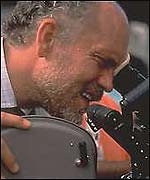
Newsnight Review discussed John Malkovich's directorial debut The Dancer Upstairs.
(Edited highlights of the panel's review)
WALTER:
I think he got over the idea that violence arrives unannounced very well indeed. The film also has this very unpredictable quality. Things are shown and then later explained. For instance there's this one brilliant scene where the policeman and the dancer are talking together about dancing, and it's intercut with a scene where people are shot in their stage performance. And you just don't know how the two correlate together at all - what the relationship is. And the film does have this very unnerving quality. You never know what is around the corner. I thought that worked very well. If I have one criticism, I think that what John Malkovich was saying about not wanting to excuse the terrorism at all. I think he takes that too far. He won't even dare to explore it and he won't show at all how this terrorism is grounded in society.
WARK:
But isn't that because he was so non-specific because he has taken an active decision to remove this from Peru and make it unspecific?
WALTER:
But I think that's problematic. Because it makes the terrorism look as though its just a kind of self-indulgent activity by middle-class people. I mean you don't get any sense that there might be desperate poor marginalised communities out there.
GERMAINE GREER:
There are plenty of poor countries in the world that didn't have a Sendero Luminoso, and didn't have an Ezekiel character, didn't have Guzman. I think the difference is his strange charisma and the way that people latch on to that. The person that figure reminds me of is actually Rajneesh, in India. If you ever went to the Rajneesh Ashram the people were completely adoring. If he'd said 'cut your throat from here to here' I think they probably would have. This whole thing about mad self-sacrifice. There is a general body of discontent.
MARK KERMODE:
It's very nostalgic. I mean for me it's not based on a novel or real events. It is like a homage to 70's cinema. It's funny, as an actor I find John Malkovich annoying and twitchy and mannered. I have to say as an interviewee I think he's rather pompous and a bit annoying as well. But what was great about this was it looked like while he'd been spending al that time on screen being annoying he hadn't been to the cinema since 1974 and therefore his entire knowledge of how to make films is based on the great period of thrillers.
Watching a film shot with long takes, long lenses, people having conversations at a distance that looked like they were overheard - a film which takes it's time and also has that balance between the stillness of conversation suddenly interrupted by these outbursts of violence. That's something we just don't see in mainstream cinema any more. I thought it was terrific to see somebody who I haven't had that much faith in the past, working in that way.
WARK:
The one thing I didn't have faith in though, was the love story, which was more developed in the novel. Which sort of blows itself out of nowhere.
KERMODE:
But the reason the love story doesn't work here is that the main function of the love story is not to be a love story between those two characters but to serve as a counter point to his loveless relationship with his wife. All the way through the course of the movie, Bardem's character loses contact with his family. We end up seeing him sort of shut out of his own life.
WALTER:
I thought it worked. They were drawn to each other because they each had this secret that they couldn't express to each other. I felt that they both felt that the other one had this hidden life.
GREER:
They used it in the poster which is most annoying. I had to think hard when did she stand naked with his hand on her waste? I'm not sure that she ever did, did she? Not in the film we saw.
KERMODE:
But it's perfectly fine for that relationship to be icy and detached and alienated in the context of that kind of conspiracy thriller which it is anyway. None of those great movies to which it refers work around fulfilled love affairs.
WARK:
Before we finish we must talk very briefly about the chicken. The dynamited chicken.
KERMODE:
Can I just say on this, and the BBFC get a lot of stick for this. The BBFC have a very simple policy:
You can't abuse live animals on screen. It doesn't matter what the dramatic context is. If it wasn't abused, as he says it wasn't, they don't cut it, if it was abused they do. It's simple, it's the Animals Act. The BBFC have got a lot of problems this is not one of them.




 E-mail this story to a friend