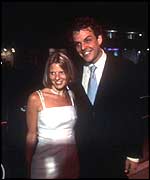
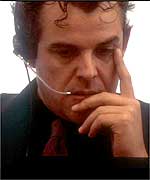
'Film is dead', or so director Bernard Rose, who shot Ivansxtc on digital video cameras, would have us believe. Based loosely on Tolstoy's 'The Death of Ivan Ilych' it follows the final crazed days of an LA talent agent - played by Danny Huston - as he dies from what local gossip believes to be a drug overdose.
(Edited highlights of the panel's review)
MARK LAWSON:
Tom Paulin, it's Tolstoy goes to Hollywood. Do you have any sense of the original in this adaptation?
TOM PAULIN:
Absolutely not. It had been about 30 years since I had read the Tolstoy, so I re-read it this afternoon. As I had remembered, the extraordinary ending where this flawed functionary, this lawyer, at the end of thinks life, in the closing moments of his life, has this extraordinary vision of freedom and peace with his family and settles terms with life, and so death is over before he has died.
That is such an extraordinary, deeply moving, ending coming out of Tolstoy's deep religious conviction. It's not understood in this film at all. So you get these trivial rich people. It's interesting the way it's shot digitally and the dialogue is quite hard to follow but authentic, but it uses a motif of underground car parks rather too much. To absolutely miss what's so extraordinary about Tolstoy grieves me.
MARK LAWSON:
Bonnie, there have been a lot of portraits of Hollywood, pretty savage in the past; 'The Player' 'Swimming with Sharks'. There was a running gag in Ivansxtc that every time they are told he has died from cancer, they assume it's a euphemism. It's more complicated than that in its attitude to Hollywood, but is it powerful in that way?
BONNIE GREER:
It is. It does look at Hollywood in a very cynical way and looks at the way it should be. I want to pick up on something that Tom said. In a way, for British audiences, the movie is a little bit unfair. There are references that come from American commercials.
For instance, the Wagner that's played through it refers to an ad that was running in America 15 years ago. In the ad, the little boy looks out of the window and sees a bird fly. It does bring back that moment into the Tolstoy. It does work in that way. But it does take on Hollywood, takes it apart and shows it the way it really works.
To have the son of one of the most powerful men in Hollywood do it adds to its poignancy. It was an incredible film. Also using the digital camera as well. Often people use it like a film camera and use the film language. This actually creates a new sort of language for the digital, so I agree with the director that it is a new step. The shape is different. The way it changes is quite extraordinary.
MARK LAWSON:
Even the casting makes a point, Danny Huston, is part of the dynasty, John Huston's son. Hari Kunzru.
HARI KUNZRU:
I think I am with Bonnie more than Tom. I also found it moving. The eruption of death into this life lived on the surface. He lives a glossy Hollywood existence with no sort of moral compass, because he is after all an agent. We see him making this devious deal by which he pulls a big client into the agency. Everything is easy, everybody is nice and lovely to each other.
Then there is this maybe slightly kitschified eruption of Wagner and death and transcendence into this surface world. Even though the people are trivial people, not especially likeable, I did like the idea of this person facing his death.
MARK LAWSON:
This film has radical ambitions, yet many of the scenes are rather traditional Hollywood scenes. For example, the one in which the central character goes back to meet his family. Bonnie, that seemed a possible problem with this film, it has very radical ambitions, it's well written but that's a pretty conventional scene, isn't it?
BONNIE GREER:
Yes, but the way it's acted is not. The way it's done is the way acting should be done with digital filming. It gives a feel of improvisation. When she is talking, Danny Huston is laughing in the middle of it, actually stepping on an actor's line. You can do that with digital because you can run the scene as long as you like. It should give you the feeling that this is actually happening.
HARI KUNZRU:
To me, the importance of digitisation is to do with film finance and money. It's cheaper and therefore you can tell stories that you couldn't get financed through a mainstream studio process. Certainly, because this particular film is very critical of the Hollywood studio process, it perhaps wouldn't be something they would finance.
TOM PAULIN:
But it can't make the shift that Tolstoy's story makes into the spiritual and the ethical and moral life. It can't do that and therefore can't create compassion and sympathy for the central character.
MARK LAWSON:
Some may see this as a minor film that happens to be opening the summer, but the director has made fantastic claims for this. He has said that film is now dead, that this is the future of cinema. That's rubbish, isn't it?
BONNIE GREER: Looking at the end of it, the arc begins to change and the film slows down. You have to pay attention to Danny Huston, who takes you through the character transformation that you say doesn't exist, Tom.
I agree with the director that this is something quite, quite new. In film, for instance, you have to because of the way every ten minutes you have to change a magazine, you get these sort of set-ups. This one has long, long takes. You actually have to focus in on this character. He gives you throwaway lines.
There is a wonderful moment when Peter Weller comes out of the automobile and slams the door on the actors, and then remembers he has done it and turns back. In film, that would be very difficult to do, because you would have to do all kinds of set-ups for it. It's a long take that's very funny.
MARK LAWSON:
Hari, I thought it was very well done, and, as you say, couldn't have been filmed in a conventional way, but the problem is this shooting technique suits mock documentaries. In the end, isn't that the only genre it works for?
HARI KUNZRU:
I felt formally this was oscillating between traditional ways of staging a film and a much freer and more documentary style thing that is emerging from digital film. This film is not on its own. There have been other films shot on digital film. It's a whole group beginning to explore it.
TOM PAULIN:
It gives the feeling of improvisation, but every word should count.
MARK LAWSON:
They are making radical claim and in the end making a movie about the movies isn't very radical, is it? BONNIE GREER:
Probably everybody hates him in LA. He says at the end of all these things there's dust. That's the end of the Hollywood dream and every dream. It's dust. That's really the radical thing that he has done.
MARK LAWSON:
This discussion is dust as well. Ivansxtc opens in selected cinemas around the country today.




 E-mail this story to a friend