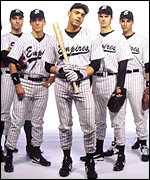
Take Me out A new play in which a baseball hero reveals he's gay, now on at the Donmar Warehouse
(Edited highlights of the panel's review)
MARK LAWSON:
Germaine Greer, a lot of British people don't know anything about baseball. Does this play explain it adequately?
GERMAINE GREER:
Absolutely not. The reason why it's premiered in England is because it could never have been premiered in the States. You made the connection yourself in the commentary that the equivalent is Manchester United here, and the culture is as dense as that.
You cannot make theatre about something that is already more interesting and denser and more complicated than anything you can put on the stage. This is actually a play about coming out in homosocial groups as gay, and how those groups will react.
I couldn't believe the stuff he was expecting people to believe about baseball. The catcher is a complete idiot. Now, if Greenberg new anything about baseball, he would know the catcher runs the game. The catcher decides the plays. He controls the infield. You don't have a catcher going, "Duh, duh." That's not what they're like, they're usually extremely hyper and quick.
They're not athletes, they're actually brain boxes. They have a very mechanical job to do. If the pitcher doesn't look at what they're saying and do what they tell them to do, the game is a bust. The game cannot happen.
MARK LAWSON:
Athletes are intelligent in different ways. David Beckham wouldn't split the atom for you.
GERMAINE GREER:
He wouldn't be a catcher either.
MARK LAWSON:
But he's sportingly intelligent. There's a difference, isn't there. Rosie Boycott, it has this very old-fashioned structure, a three act play, which is partly playing on the importance of number three in baseball. But its also an old-fashioned narrative play with ideas he's trying to write.
ROSIE BOYCOTT:
I think he does it incredibly successfully. I have a memory, and I don't know what Kerouac book it was, and I read it when I was about 17, that baseball is holy to America. I thought it was wonderful the way he talks about how baseball is the ultimate democracy because it's a team of guys, but always one guy loses because we're mature enough to understand it.
I thought it was a really well-staged play. I thought it was well-acted. I loved when he came out, how the whole thing became a conflict. I thought the introduction of the hick character of Shane was brilliant, how Shane becomes, to start with, this bumbling person to whom you're sympathetic, and then turns round to being a big monster. The whole of this small set-up is thrown into total chaos and confusion, which actually makes for electrifying theatre.
The set itself was rather brilliant. When they actually go into their moments of performance when they're chucking balls and throwing balls, it lives and it's alive. The shower scenes work, and it's done without embarrassment. I was engaged. I can't think how you can sit here, Germaine, and say�
GERMAINE GREER:
Because I like baseball, and because you don't give a damn about baseball.
ROSIE BOYCOTT:
: But I became interested in baseball as a result of it.
GERMAINE GREER:
No you didn't, because whatever you became interested in wasn't baseball. Whatever it gave you was an outsider's view of baseball.
ROSIE BOYCOTT:
Why can't baseball be a metaphor for the final outpost of this group of men who suddenly get their lives interrupted by a gay man. They've learned to deal with black people, but the gayness is something that throws them, and then they get further thrown by this hick who comes in and calls him a faggot.
TOM PAULIN:
The hick was the only character I was interested in. This was a hopeless redneck, completely inarticulate, stupid. A disgusting parody of a redneck. I didn't share his racist and homophobic views, but that hopeless speech he gives� Then he stood down from the team. Utterly ridiculous. Absolutely dreadful.
It's a political correctness of the worst kind, and to watch it in England, where nobody gives a damn about people's sexuality. The person he killed must have been a hopeless, hopeless baseball player to actually get killed.
MARK LAWSON:
We're talking about plot twists in this play. It's more subtle, I think, than you suggest. The characters never behave in the way that they're expected to. You have the athlete who comes out as gay but isn't actually very interested in sex at all. You have this hick who�
TOM PAULIN:
Who cares!
MARK LAWSON:
You have this hick who is completely inarticulate, can't say anything. He manages to say one articulate word and it fires the next part of the play.
TOM PAULIN:
The poor fellow should have been the centre of the play, a sort of Gary Gilmore character, he should've been. But it was absolutely dreadful the way he was treated.
ROSIE BOYCOTT:
He was in there to explode this group. They were a group of people who represented old-style America.
TOM PAULIN:
They didn't hang together as a team.
ROSIE BOYCOTT:
They did. They took showers together, they talked together.
TOM PAULIN:
They were just a conglomerate of individuals.
MARK LAWSON:
I thought it was a remarkable play. There is a key line where the financial adviser, who has never liked baseball, is worried about being gay, he suddenly says, "It's the only crowd I've ever agreed with."
This play is about the crowd and the individual. It's all about that, and the relationship of individuals to crowds is worked through in every character. Germaine?
GERMAINE GREER:
The Shane character is very interesting because he tells you that his father killed his mother and committed suicide when he was 14 weeks old. Then he's had a series of families, he's been kicked from pillar to post. He's somehow come from Triple A Utah, the minor leagues, into a World Series-winning team. Impossible, for a start, but he's done it.
ROSIE BOYCOTT:
Absolutely not impossible. You can get baseball scholarships from schools. You can be a great thrower, and you can end up there.
GERMAINE GREER:
Believe me, you cannot do it like that.
MARK LAWSON:
It's that democracy theme it's got going. It's the idea that anyone�
ROSIE BOYCOTT:
It's saying anyone can succeed in America. It's a big metaphor for the whole of what people believe of the American dream.
GERMAINE GREER:
You don't do it like that.
TOM PAULIN:
Being a great sports person is being intelligent.
MARK LAWSON:
It's not being intelligent in that way, Tom. I've followed sport all my life. They're not geniuses, the lot of them. That's not what they're there to do.
TOM PAULIN:
They're not stood down from teams. Supposing years ago George Best had said I support Sinn Fein or I support Ian Paisley. Would he have been kicked out of Manchester United? Certainly not.
ROSIE BOYCOTT:
But they didn't kill someone.
TOM PAULIN:
That was later on.
GERMAINE GREER:
This is all to do with the fact that you know nothing about baseball.
TOM PAULIN:
He didn't murder him.
GERMAINE GREER:
High balls are thrown all the time. Not only that, you wear a helmet with a cheek guard. How did he kill him? It has to be accidental. But it's treated as murder. Believe me, it would not have been treated as murder.
ROSIE BOYCOTT:
It was treated with suspicion.
TOM PAULIN:
What would've happened in a game of cricket?!
MARK LAWSON:
But plays aren't just social realism, are they?
GERMAINE GREER:
No. But if you're going to use a World Series-winning team as an analogue for something, you have to get it a little bit right. They could have just set it in the minor leagues and it would have been true enough. None of it rang true at all, especially about the real complexity of the game. As for making a comparison with democracy, it's like comparing jam with marble.
MARK LAWSON:
No it isn't, in fact it all works because you get three goes and all of that.
GERMAINE GREER:
That's not true either. It is not a game of numbers. That would be like talking about Wimbledon in terms of the dimensions of the court and the size of the net.
MARK LAWSON:
Or the scoring system, which is very important in tennis. Very quickly, a lot of people won't be going for the baseball, Rosie, they'll be going for these two shower scenes. Seven naked men on stage. It's an extraordinary thing. A lot of people won't care, but is it dramatically justified?
ROSIE BOYCOTT:
It's done so casually. It reminded me of opening up those copies of Marie Claire or Company in the past, when they said, "Actually, girls, all willies are different."
GERMAINE GREER:
Not in America. They've all been surgically altered to be the same.
ROSIE BOYCOTT:
Some are long and some are short, and some are fat and some are not.
TOM PAULIN:
It's a gay troupe, the shower scene. It's Hockney, you get it in all sorts of gay art.
ROSIE BOYCOTT:
It could be also for the girls, Tom. It was quite fun to see.
MARK LAWSON:
We'll leave it there. It was struck out over there, but it was a hit on the third strike from Rosie.




 E-mail this story to a friend