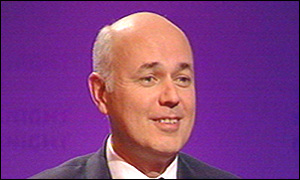
Jeremy Paxman interviewed Iain Duncan Smith, the leader of the Conservative party, on 25th July 2002.
JEREMY PAXMAN:
Iain Duncan Smith joins us now. Iain Duncan Smith, why did you sack David Davis as chairman?
IAIN DUNCAN SMITH:
Jeremy, I don't know if you have ever employed anybody, I don't know if you should say sacked when I moved him into a shadow job, one of the most senior jobs in government, deputy Prime Minister.
PAXMAN:
Is it a promotion?
DUNCAN SMITH:
Let me walk you through this. I thought when I saw the Government's reshuffle, about a month and a half ago. I thought their main drive, their big drive for a campaign would be with the Deputy Prime Minister. He now has the job of campaigning, making regional Government work. We are opposed to that, because we believe it will cost at least �2 billion. I wanted somebody who is a good campaigner, I thought David Davis would do that job perfectly. I offered him the job and he accepted it.
PAXMAN:
He has been on a holiday for two weeks. A holiday that was cleared in advance by your office. At what point in that two weeks, did you decide he had to be moved.
DUNCAN SMITH:
When I spoke to him.
PAXMAN:
On a mobile telephone?
DUNCAN SMITH:
Look, I don't want to get into details of these things. I decided what I wanted. He is a very talented politician. I believe what he had done was enough and we needed to move on.
PAXMAN:
If he is such a talented politician and you respect him so much, didn't he at least deserve to be told face-to-face.
DUNCAN SMITH:
I've spoken to David Davis. It's enough to know that he and I agreed that this is the job he would do. He has accepted it. It's the same going for the person I put in as chairman. I was elected leader to make the decisions about the direction of the party. He is shadowing one of the most senior departments in Government. One of the biggest departments, somebody who has been given the task, the Deputy Prime Minister, of running what I think is Labour's biggest campaign over the next 12 months, a very serious job. I'm happy he has accepted it.
PAXMAN:
You feel it was perfectly appropriate that despite his being on holiday, a holiday he cleared in advance with you, at the time that you took a decision that you would sack him over a mobile phone call?
DUNCAN SMITH:
I haven't sacked anyone. Jeremy have you ever employed anybody?
PAXMAN:
No.
DUNCAN SMITH:
If you sack somebody they disappear out of their job and not employed any longer. David has done a good job. I think he will be absolutely perfect to take on the Deputy Prime Minister, who I believe will campaign for a ludicrous programme of creating regional governments. What I've done is ask him to do that job. He has said he will do it. That is as far as I'm concerned, that is the reality. I have asked him to do it, I'm the leader and he has accepted it.
PAXMAN:
So when we read that quote, "it's pretty obvious there have been dark forces at work taking advantage of his absence", do you recognise the quote?
DUNCAN SMITH:
I recognise the novels that you may ever want to read. It sounds like a novel.
PAXMAN:
It's the Shadow Leader of the House, your man Eric Forth.
DUNCAN SMITH:
The reality is that David was offered a job. He has accepted it. I believe he is a very skilled politician. The whole shadow cabinet reshuffle was centred against the cabinet reshuffle. Jeremy you can go on about this amount of detail, it amazes me that all you want to discuss is the nonsense. Your view is out there. I'm not interested in who did what to who...
PAXMAN:
You say it's your decision, here's a member of your own cabinet talking about "forces of darkness" being at work, taking advantage of a man's absence on holiday.
DUNCAN SMITH:
I shouldn't believe everything you read. I'm telling you now, the truth is...
PAXMAN:
Have I misquoted Eric Forth?
DUNCAN SMITH:
I don't read that nonsense.
PAXMAN:
You don't read the Financial Times?
DUNCAN SMITH:
I don't read nonsense like that...
PAXMAN:
What papers do you read?
DUNCAN SMITH:
I'm leader and I have to decide who is in my cabinet. David and I talked about it. David accepted that job. I happen to think he will do a good job at it. He will move the party into a campaigning role.
PAXMAN:
Isn't the real reason that he was sacked because he wants your job?
DUNCAN SMITH:
I don't agree that's the case. No.
PAXMAN:
It has never crossed your mind that he may want to succeed you?
DUNCAN SMITH:
My party is very happy now, they elected me as leader. The party wants me to reshape the party over the next four years and fight the next election and beat a Government, that I believe, is destroying the quality of life for people across the country.
PAXMAN:
In order for you to do that you need to be taken seriously as a coherent party.
DUNCAN SMITH:
I agree.
PAXMAN:
When you have failures as big as Kenneth Clarke and Michael Portillo and when Ann Widdecombe can't work under you, you don't look like a party, you like look like a sect?
DUNCAN SMITH:
You say that, I believe we are rapidly establishing ourselves as a broad party that represents the public's interests and concerns. You can talk about individuals and personalities. For the most part, I don't think those who are watching this programme have the slightest interest in that. They want to know, is this man, am I, able to establish the Conservative as a party that really believes that they can change and improve the quality of people's lives and come forward with policies that will reform the health service and improve education in inner cities and put police back on the streets. That is really what this is all about, not the flim flam over who is doing what.
PAXMAN:
I'm not talking about flim flam, it's your own description of your party, in which you said recently that it's been possible for you to be labelled as "nasty, extreme and strange".
DUNCAN SMITH:
What I'm saying is, quite rightly, that the problem for the Conservative Party is that we have to break out of the box that Labour and the media labelled us as. We are a party that isn't just about one or two issues. We are a party that is a broadly-based party that needs to be able to campaign and have policies on issues that matter to British people. I don't want to change my party into something that it's not. I want to change it to the party that I joined, a party that helped people on marginal incomes, people in difficulty, people in inner cities as much as anybody else. That is what we will be about under my leadership.
PAXMAN:
We will come to principles and policies in a moment. In order to put them into effect, you need to be making progress.
DUNCAN SMITH:
I agree.
PAXMAN:
You joined Parliament in 1992?
DUNCAN SMITH:
Yes.
PAXMAN:
Do you how many seats you have gained in by-elections since then?
DUNCAN SMITH:
We haven't gained in by-elections other than the seats we have held.
PAXMAN:
Do you know when you have last gained a seat in a by-election?
DUNCAN SMITH:
I don't spend my time worrying about what happened 20 years ago.
PAXMAN:
It was 1982.
DUNCAN SMITH:
We had come out of a period of opposition and had just formed a Government. All I'm saying to you is, I accept all of that. We have to make progress. I'm not here being stupid and claiming some idiotic idea that with one bound we are free. I want to be honest about this. I have to get my party, so they are rebuilt into a state so they can fight the next election on a broad platform and goes to the heart of what worries people. People are worried about the state of their health service and worried about the fact that their children, particularly in inner city areas, get an appalling level of education. They are worried about the fact that their children are often robbed and beaten up on their way to school, violence that takes place on the streets is greater than it's ever been. We have to get on to those issues.
PAXMAN:
Why haven't you got any policies?
DUNCAN SMITH:
We have got policies.
PAXMAN:
On what?
DUNCAN SMITH:
All of the subjects I've given you.
PAXMAN:
Detailed policies?
DUNCAN SMITH:
We have policies, the detail of how we deliver them will be fleshed out over the next few months and years as we find that the right time to deliver them is here. An example, education. We've already said there is a massive disparity between inner city education and those in the boroughs. Half of that is caused because the Government has centralised all of the decision-making on Whitehall. Schools cannot take decisions, they can't exclude pupils, teachers spend less time in the classroom. What we want to do is reverse that process, give the power back to schools and the head teachers. Give them the power to spend their money and make decisions and to get the children taught by teachers that spend more time in the classrooms than they are at the moment. Most of all they are lacking in discipline. Why? Because the Government took away their powers to discipline children. That is a clear set of policy objectives we want to bring forward and we will detail and flesh out those in the next few months.
PAXMAN:
Those are philosophies rather than specific policies, aren't they?
DUNCAN SMITH:
They are practical objectives.
PAXMAN:
Let me ask you a practical question. At the time of the last election you promised you would match Labour's spending on health and education, is that still the case?
DUNCAN SMITH:
I don't believe it would be right to say that everything Labour is spending we will match. That is pointless. We don't think they are spending the money properly. They have taxed people on low and marginal incomes. They've spent more money on the public services. If money alone was the solution, don't you think we've had dramatically improved hospitals and dramatically improved schools. We don't have, in fact. Northern Ireland and Wales spend as much money on health per capita as they do in France, yet the services are worse there than they are in England. I'm saying without reform, simply spending the money will not be enough. We want to reform the system first, then say how we will spend the money and then say how much money is necessary to be spent.
PAXMAN:
Is the Government spending too much money?
DUNCAN SMITH:
They are spending a huge amount of money badly. If they go on spending the money and taxing more, they will not deliver better public services.
PAXMAN:
Public spending is roughly 40% of GDP, predicted to be 45%. What ought it to be?
DUNCAN SMITH:
I don't have a notional figure in my head.
PAXMAN:
You used to. In July 1995, you said it should be in the middle 30s?
DUNCAN SMITH:
I can tell you now, I do not have a figure written down or published.
PAXMAN:
Why could you then and not now?
DUNCAN SMITH:
I didn't say an absolute then. I said it was a notional view.
PAXMAN:
You wanted it in the mid 30s?
DUNCAN SMITH:
John Major and the Prime Minister had talked about bringing it to the middle 30s and I said that may be a good objective.
PAXMAN:
When you said that in the House of Commons, you were just parroting something you didn't believe?
DUNCAN SMITH:
I said, those objectives may be very good. My point is I don't have an objective.
PAXMAN:
You said you should be aiming for it?
DUNCAN SMITH:
It's wrong to sit here and say we have a categorical objective. The Conservative Party knows this much, I know this much, that an economy that is a low-tax economy, is a more efficient economy that can deliver more money for public services.
PAXMAN:
Essentially, you are a Conservative who doesn't believe in a smaller state?
DUNCAN SMITH:
I do believe in a smaller state. That's one of my principles.
PAXMAN:
What proportion do you want to see on GDP, roughly?
DUNCAN SMITH:
You go about it in the wrong way, which will actually deliver us into chaos. I want, first of all, to show the public that we have a clear sense of how we will reform and change the public services, which are the biggest users of public money. Once we have shown how that reform can be made, we then say how much money needs to be spent and how that money will be raised. At that point, we are able to say, legitimately, this means so much money will be taken in tax, others that may be used through insurance systems or whatever systems we come up with, which will allow us to set the tax position clearly so the public understand us. To start talking about notional figures, about what we seek to achieve or not, you and I both know would be ludicrous.
PAXMAN:
You have been prepared to do so in the past, which is why I asked. Do you agree with the basic proposition that the Conservative Party is a tax-cutting party or it is nothing?
DUNCAN SMITH:
It is a believer in a smaller state and believes in delivering that through lower tax. It always has been and always will be. You would be the first to attack me, if I was to come out suddenly and say, "I know exactly how much tax we will raise after the time this present government leaves", I would have to know a number of things. First, exactly how much tax the Government is raising at the time they leave. I will deal with the principles of that. I would seek to take less from people if I could in taxation, but the point is first to make that...
PAXMAN:
That is your objective?
DUNCAN SMITH:
That is my objective. To make it sensible, I have to show that I have a reform programme that will deliver improved services and I will show them how we will pay for it. Any other way of doing it is flim flam, silly.
PAXMAN:
So, you were just being silly when you expressed the aspiration of it being in the mid 30s?
DUNCAN SMITH:
There is nothing wrong with aspirations. It's how you deliver them. The public don't want aspirations, they want us to say how we will deliver these policies. I think I owe them that.
PAXMAN:
Looking at health, you have had people tootling around Europe looking at other health systems. Do you believe that healthcare in this country should be free at the point of delivery?
DUNCAN SMITH:
I believe the principles of the health service are that people who need treatment should receive it, regardless of their ability to pay, when they need it, at the quality that they actually need.
PAXMAN:
Should it be free at the point of delivery?
DUNCAN SMITH:
I believe in principle it probably will be...
PAXMAN:
I am not asking whether it will be, but whether you think it should be?
DUNCAN SMITH:
When you say "free", the health service isn't free at the point of delivery now. You pay for dental treatment, many people pay for prescriptions. You pay through taxation. Let's stop this silly, stupid, Labour argument that says the health service is free or else it's not. If this Labour Government wants it to be free at the point of delivery, they should take away all the charges, but they haven't done that.
PAXMAN:
Would you have us paying to see a GP?
DUNCAN SMITH:
I'm looking at that, but I have to tell you I don't believe, I am not persuaded by the argument of that. I don't see it's that effective.
PAXMAN:
You are prepared to countenance British people paying to see their GP?
DUNCAN SMITH:
No, I am not. I will look at the arguments and I will discount them if they don't work.
PAXMAN:
So you are looking at this?
DUNCAN SMITH:
Of course I've said I'm looking at it! I am looking at whether we widen the provision of the health service, how much private and voluntary provision there should be. But don't you think it would be stupid of me to say that the Conservative Party is going to reform these services, but what we are not going to do is look at any way of reforming them? Doesn't that sound a bit stupid to you?
PAXMAN:
What about the idea of paying bed and breakfast charges for staying in hospital?
DUNCAN SMITH:
The present government is willing to do that.
PAXMAN:
What is your belief?
DUNCAN SMITH:
I will let you know in good time exactly how we will deliver this broader health service, which will include greater private and voluntary provision, and how we will pay for it.
PAXMAN:
What we are trying to establish here is what the limits are of this consideration For example, do you think cosmetic surgery should be available on the NHS?
DUNCAN SMITH:
I don't think that it necessarily should be but I leave that to the health authority. I believe in a decentralised system where health authorities make the decisions necessary for those who live in that area. There will be variable decisions made according to demand, but that is very much variable. IVF often varies from health authority to health authority.
PAXMAN:
You are happy with that?
DUNCAN SMITH:
I think if you believe in hospitals and doctors and those who run those hospitals, taking decisions to match the need of people locally, you have to allow a certain amount of flexibility, otherwise you do what the Government does, which is centralising more and more decisions on a minister in Whitehall, who doesn't live anywhere near the people who need the services.
PAXMAN:
On the question of GPs, to be clear on this, you are considering whether or not people ought to pay to see a GP?
DUNCAN SMITH:
No, I am not considering whether people ought to see whether they should pay for their GPs.
PAXMAN:
You just said you were working out whether it was a good idea or not?
DUNCAN SMITH:
What I said was, we will look at all the possibilities there are for reform.
PAXMAN:
So you are considering it?
DUNCAN SMITH:
I am not considering doing it, but looking at what is viable.
PAXMAN:
What is the difference between looking at it and considering it?
DUNCAN SMITH:
If we consider it, apparently it's done and in the box marked policy.
PAXMAN:
No, no-one is suggesting that, but you are thinking about it?
DUNCAN SMITH:
I will look at it, certainly, but I will also look at whether or not insurance is a good idea, or whether general taxation is the most efficient way of financing a health service. What I don't agree with is that the Government's view that there is only one way to run a health service, which is the way we run it now, I am saying the way it is run now is clearly not working. If everybody else out in the Western world gets a better health treatment and better standards than us, surely I should look at the way they do it and consider it.
PAXMAN:
Let's look at an area in which you do have a pretty clear policy, which is the euro. What is it specifically about the euro that makes it such an inflexible matter of policy?
DUNCAN SMITH:
I just don't believe it's right for Britain.
PAXMAN:
Under any circumstances?
DUNCAN SMITH:
I believe if it were adopted, it would be about people giving away the power to make those decisions for themselves. I think it is a matter of principle. Our policy is that the Conservative Party, whenever that referendum is called, will campaign against the euro, against scrapping the pound. All I am saying is that my party will be grown-up about it. Those who disagree will be allowed to campaign for entry, if they believe in it, and if they are in the Shadow Cabinet they will be allowed to stand down and campaign for it.
PAXMAN:
Despite the fact your own director of strategy says that for many people just about the only thing less popular than the euro is the Tory party?
DUNCAN SMITH:
Every single political party is less popular than the pound. That is why I intend to campaign to keep the pound. The Labour Party is less popular than the pound, and if they were to campaign to scrap the pound, all I can say is they would probably make that campaign and destroy it anyway.
PAXMAN:
What he's saying is, if you start coming out in favour of the pound, others are going to switch to the euro?
DUNCAN SMITH:
What he's saying is that no single party should dominate the debate. I will lead the debate for the Conservative Party...
PAXMAN:
It specifically talks about you?
DUNCAN SMITH:
It talks about the Conservative Party. No political party is more popular than the pound. The Conservative Party is not more popular than the pound, but nor is the Labour Party and the Liberal Democrats. That's why I actually believe that, if you campaign to keep the pound, it's doing something which the public want. I think that's a very good idea. Don't you?
PAXMAN:
Do you think I am going to walk into that?
DUNCAN SMITH:
You might. You never know.
PAXMAN:
Can we look at your attempts to change your party. In your 60 most important seats, you have so far selected 22 candidates. 16 of those I think are men. There is no member of an ethnic minority. Is that satisfactory?
DUNCAN SMITH:
I want to improve the opportunity for women and for members of the ethnic community in my party to become candidates as councillors and MPs. At the moment, it's early days. We are doing early selections on marginal seats. We have selected about a quarter of the seats which happen to be women, which is better than at this time in the Parliament last time round, although we want to do better. That's what we are striving to do. We are getting more women and ethnic candidates coming forward on to the list. I have changed the process. David Davis changed the process of selection. That is working and we are getting more coming forward. That's beginning to work.
PAXMAN:
You are prepared to make local parties abide by those rules?
DUNCAN SMITH:
I am not going to start directing them. That's not how our constitution works. I want to provide them with a better range of candidates. The problem we have had is that they don't have as much choice of women and ethnic candidates as they should. I think many of the associations really would like to choose a broader range of candidates, so we have to present them with that broader range, which means getting more to come forward. If more women or ethnic candidates share my values and principles, they are Conservatives, I want them in the party with opportunities to get on to the list and to become MPs.
PAXMAN:
Shortly after you were elected to the leadership, you said you were "not overconfident" about whether you would win the next election?
DUNCAN SMITH:
I don't think it's good for politicians to be overconfident. I was confident, though.
PAXMAN:
If you become the third person after Austin Chamberlain and William Hague to be leader of the party and not to become Prime Minister, will you resign?
DUNCAN SMITH:
That is not going to happen, I plan to win the next election.
PAXMAN:
Are you serious?
DUNCAN SMITH:
I am absolutely serious Jeremy, I will crack a bottle of champagne with you when it's done.
This transcript was produced from the teletext subtitles that are generated live for Newsnight. It has been checked against the programme as broadcast, however Newsnight can accept no responsibility for any factual inaccuracies. We will be happy to correct serious errors.




 E-mail this story to a friend