War Against Terror At the time, the government said it would safeguard our way of life against those who sought to destroy it. September 11th made it an urgent matter of national security.
The Anti-Terrorism, Crime and Security Act got the royal assent in December. It gave the government the right to lock up several foreign nationals thought not to have committed crimes but suspected of planning to commit them.
They are about to bring the first legal challenge to their captivity.
Peter Marshall has been following the so-called war against terror.
PETER MARSHALL:
On December 13th, the Anti-Terrorism, Crime and Security Act became law. It permits the arrest and indefinite detention of foreign nationals without charge, without trial and without sentence.
On December 19th, eight men, seven from North Africa, the other a Palestinian, were picked up by police and immigration officials at addresses around the UK. All, bar one, were refugees or seeking refugee status. Two were clients of a Birmingham lawyer.
NATALIA GARCIA:
They were arrested early morning. For example, one of them, who is a family man with a small baby, was simply told, "We have a decision to deport you. You must come with us. Take a small bag."
MARSHALL:
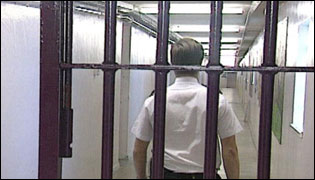
It was weeks before he was allowed to phone his family, and three months before they were allowed to see him, for he was, and remains, interned, locked up in a high-security prison.
GARCIA:
It's very harsh indeed. They are being held as category A high-security prisoners, on a remand regime as if they had been charged with serious criminal offences, although they haven't been charged with anything at all. They are held in their cells alone for between 21 and 23 hours a day. Whenever they have visits, whether they be legal visits or social visits, they are strip searched both before and after the visit. So on a day, for example, if they have two legal visits on the same day, they will be strip searched four times on that day.
MARSHALL:
That happens?
GARCIA:
Yes, that happens.
MARSHALL:
By the early summer, three more North Africans have been interned, like the others deemed a threat to national security. All detainees are allowed to choose deportation rather than prison, but because of the apparent danger of returning to regimes from which they fled, only two have left. One, not a refugee, offered to go back to Morocco. The other was acceptable to France. The rest are still inside.
Miss Garcia says as a human rights lawyer she never expected this sort of thing to happen in Britain. As a Muslim, she says, the law is alienating people of her faith.
GARCIA:
I wouldn't call it evidence. What it amounts to is a collection of newspaper articles, items off the internet, concerning cases going back as far as 1998. None of them have any specific relation to our clients.
MARSHALL:
What sort of information is it, then?
GARCIA:
It's simply about, for example, they bring the case of Raissi in it to give an example.
MARSHALL:
If the security services say this man is an international terrorist, they are at odds with the judiciary and behind the times. The man was acquitted, released by a judge earlier this year, after FBI evidence against him was shown to be inaccurate and based on misunderstandings. Mr Raissi and a number of other supposed contacts of the detainees have proven their innocence, yet the detainees are considered guilty because of association with them. What's more, he only established innocence because his lawyer was able to investigate all the evidence. With the detainee, this can't happen, because much of the case against them is based on intelligence sources, and thus secret.
GARCIA:
It is what they call the closed evidence, which we never see and which we can't challenge. Based on what they have provided in the open evidence, which is nonsensical, contradictory, inaccurate, it is fair to suppose that what's in the closed evidence is likely to be the same. It's also fair to suppose that the sources of that material are likely to be the very repressive regimes that the clients fear, and information from those regimes is clearly unreliable.
MARSHALL:
There are many further apparent illogicalities, according to the lawyers. This is Abu Hamza, the controversial mullah from the London mosque. Contact with Mr Hamza makes the detainees into international terrorists yet he himself remains a free man.
This transcript was produced from the teletext subtitles that are generated live for Newsnight. It has been checked against the programme as broadcast, however Newsnight can accept no responsibility for any factual inaccuracies. We will be happy to correct serious errors.




 E-mail this story to a friend