Britain's prisons We revealed new research showing just how over-stretched prisons have become in England and Wales.
Our story came within weeks of violent disturbances at three jails.
We've had exclusive access to the views of the independent monitors who see inside the prisons - and they are overwhelmingly concerned about overcrowding leading to assaults, damage to the prison regime and an increasing lack of safety inside.
There are more people serving life sentences in England and Wales than in the whole of the rest of Western Europe - and the total number of prisoners has rocketed to more than 70,000.
Richard Watson looked at the consequences.
RICHARD WATSON:
Degrading and inhuman.
Grinding to a halt.
Potentially explosive.
These are the words from prisons across the country describing a system at breaking point. It's clear something has to give, and soon, if long-term damage to the prison system and violence are to be avoided, as the numbers locked up continue to climb.
UNNAMED OFFICER:
If you are going to take in more prisoners into establishments that are designed for half the numbers, and you are keeping them locked in their cells for extended periods of time, then when they do finally come out there is the potential for serious unrest.
UNNAMED MAN:
We're not geared up to take those sort of numbers. We're on the verge of a crisis, yes.
RICHARD WATSON:
Newsnight has been given exclusive access to survey information from the chairmen of Boards of Visitors, groups of independent monitors attached to local prisons.
53 out of the 60 responses received report serious problems or concerns about overcrowding.
15 prison boards warned of more assaults and threats to safety.
The prison service is in crisis. More than 71,000 people are locked up. There is talk of unrest, and emergency measures such as prison ships and prefabricated buildings.
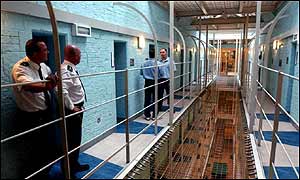
We've come to Chelmsford Prison in Essex to see how overcrowding is affecting the prison regime. The regime at Chelmsford has improved since being criticised by the Chief Inspector of Prisons two years ago. Now the good work is in jeopardy.
This man's story is one reason why. He is from Essex. He was sentenced close to home and sent to his nearest prison, Chelmsford, six months ago. He only has eight weeks to serve, but today he's been told he's has to move further from home to Norwich Prison. Chelmsford needs the space for incoming prisoners just sentenced.
PRISONER: I'm getting transferred to Norwich. Not happy today. I like in Essex, now my mum can't come and visit me.
RICHARD WATSON: As he leaves Chelmsford, this farrago is repeated at prisons everywhere, a desperate juggling act controlled centrally by the Prison Service.
31 out of the 60 prisons who have responded to the survey said relentless movement of prisoners was causing serious problems. One board of visitors said the distance from families was "distressing for juveniles". Another said pressure on staff was "intolerable". Chelmsford had similar concerns.
PAUL HALEY:
(Governor, Chelmsford Prison)
It's a problem about which we can't seem to do anything. So to plan ahead is very difficult and to create spaces very difficult.
RICHARD WATSON:
Some people would say it is crazy, that a person serving 3 or 4 months would be transported 200 miles away.
PAUL HALEY:
Yes, it is.
RICHARD WATSON:
People are being moved all over the country at short notice, and those family relationships have been damaged.
MARTIN NAREY:
(Director General, Prison Service)
Family relationships will not be helped by moving. We will do all we can to try to make up for the disruption because, but I'm not pretending it isn't of course, a great deal of difficulty, but the point I have to make is I have no choice, I don not have a waiting list, this is not like the health service, it is not like European prison services. You have been to Chelmsford, whoever is committed to Chelmsford Prison tonight, Paul Haley must accept them.
RICHARD WATSON:
Paul Haley and his boss, the Prisons Director, are most concerned about damage to rehabilitation courses. The inmates weren't slow to point out the problems.
PAUL HALEY:
Any concerns?
UNNAMED PRISONER:
Now you've started doubling up , there's not enough room to swing a goldfish.
RICHARD WATSON:
This should be a single cell, but since the governor had to accept a further 76 prisoners, he's had to double up.
PAUL HALEY:
We've now got 20 cells on this wing and 20 on the other wing we've had to double up. A bunk bed for two people, extra locker, table, chair, and now we have had to introduce a privacy screen in front of the toilets.
RICHARD WATSON:
18 prisons told the Prison Reforms Trust that they were already doubling up, with some boards of visitors describing the practice as "degrading and inhumane".
MARTIN NAREY:
I think doubling up is pretty gross, to be frank. And tonight and every night some 13,000 men are sharing two for one and they'll have to share a toilet in that cell. That's not the way I want prisoners to be treated. And the fact that the number of prisoners living in those conditions is increasing is very troubling for me and I know it's troubling for ministers too.
RICHARD WATSON:
You can feel the tension here. There are 130 more prisoners here than normal capacity.
MARTIN SALES:
(Prisoner)
These were made for single bang-up. I've been in and out since '97. Doubling up on the ones but the phones are still the same, so you get fights on the phones all night.
THOMAS CUMMINGS:
(Prisoner)
The alarm bells have been going off pretty regular. I've been in prison before, but overcrowding causes problems. It gets explosive, people find things to hit each other with. It's getting worse.
RICHARD WATSON:
Thomas Cummings is one of the luckier ones, he spends much of the time out of his cell working in the kitchens. He thinks overcrowding is partly to blame for the death of an inmate.
THOMAS CUMMINGS:
I knew one of the youngsters who died, he'd hanged himself in the block when they found him. I hadn't seen him for a long time, but he came for a chat. He got into the general population, where they're locked up a lot. No-one for him to turn to, staff are preoccupied with running a prison.
RICHARD WATSON:
This was the second death in custody in a year for Chelmsford. If they both turn out to be suicides, it would reflect a worrying national trend. After falling figures for years, prison suicides are up again.
Juliet Lyon, director of the Prison Reform Trust, believes overcrowding is behind the rise and that it's time for a fundamental shift in sentencing policy to remove prisoners on short sentences.
JULIET LYON:
(Director, Prison Reform Trust)
Let's get them out of the system and work with them more effectively within the criminal justice system, and let's reserve prison for the people who have committed serious offences. By imprisoning them, we're reducing their chances for future employability, housing, relationships and friends and consequently, creating a cycle of crime, which we are just perpetuating by the over-use of imprisonment.
RICHARD WATSON:
At Chelmsford, evidence that the prison is being choked with those on short sentences wasn't exactly hard to find.
RICHARD WATSON:
What are you in for?
UNNAMED PRISONER:
Driving while disqualified.
RICHARD WATSON:
How long did you get?
UNNAMED PRISONER:
Five and a half months.
RICHARD WATSON:
Is that going to make you a better person?
UNNAMED PRISONER:
Not really. I'm meeting all these armed robbers, so it's not good, is it?
PAUL HALEY:
About 50% of convicted prisoners are serving six months or less. We can't change their behaviour when they get outside. We have now earned the nickname of "Revolving Door Prisoners", because while they with us, very little is happening in terms of any positive alteration to their lifestyle inside.
MARTIN NAREY:
The message is for the courts. 14,000 times last year, people were sent into my custody for one month or less. 40,000 times, people were sent for three months or less. It's a waste of time and money. It's making the work we can do with longer term prisoners difficult.
RICHARD WATSON:
Could John's story be the route out of this mess? He's served time for theft linked to drug addiction. Like thousands of other drug offenders, prison did nothing to curtail his habit, or his crime.
JOHN:
(Prisoner)
I came across heroin when I was doing a six-year prison sentence. I was in the Mount Prison in Hemel Hempstead. I was smoking cannabis in one of the cells, and a fella come in and he had some heroin., and would we like to try it.
RICHARD WATSON:
Last year, John faced yet another prison term for theft. This time, he was offered the chance to avoid prison if he agreed to drug treatment. The court sentenced him to a Drugs Treatment and Testing Order, designed to help him off drugs, and therefore stop his offending. He's had to undergo weekly urine tests and monthly meetings with his judge.
JOHN:
I tested negative all the time.
RICHARD WATSON:
So the crime stopped?
JOHN:
The crime stopped, definitely. I haven't committed a crime for over a year
RICHARD WATSON:
How does that make you feel?
JOHN:
I feel proud inside, because everyone praises me, my family and the probation and everyone. And I think I've come a long way in a year from being a no-good junkie criminal, to all right now.
RICHARD WATSON:
But so far the numbers on community sentences are low. Resources for drug treatment are scarce and short sentences for non-violent crime are still being handed out.
PAUL HALEY:
It's on the verge of a crisis, without a doubt. Over 71,000 prisoners were locked up at the end of last week, and we're not geared up to cope with them. We're in crisis. There's no two ways about it.
RICHARD WATSON:
Prefabricated prison buildings are being prepared. The Prison Service says we can no longer build our way to a successful penal policy in the longer term.
For the Government, changing the sentencing framework is a sensitive issue. Will pressure now be applied to the courts to find alternatives to prison, and more importantly, will the resources in the community be there?
This transcript was produced from the teletext subtitles that are generated live for Newsnight. It has been checked against the programme as broadcast, however Newsnight can accept no responsibility for any factual inaccuracies. We will be happy to correct serious errors.




 E-mail this story to a friend