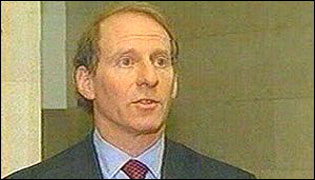
State Department's Director of Policy Richard Haass came to London to try to enlist allied support. Jeremy Paxman asked him what benefit we on this side of the pond get out of the relationship between the USA and Europe.
The American government has accused Abdullah al Mujahir of preparing to attack his own country with a so-called "dirty bomb" - a device intended to spread radioactive material over a wide area. The Americans believe they've forestalled a potentially devastating assault and have effectively tried the man without putting him before a court, classifying him as an enemy combatant.
If this arrest is all it seems, nothing could have confirmed better America's conviction that it is already at war. It seems to endorse the belicose rhetoric coming from the United States, talking about the need to go on the offensive.
The State Department's Director of Policy, Richard Haass came to London to try to enlist allied support. When Jeremy Paxman met him - before the Americans announced their counter-terrorism coup - he asked him what benefit we on this side of the pond get out of the relationship between the USA and Europe.
RICHARD HAASS:
First of all, you associate yourself with the country, the United States, this is not a boast, but it's simply the most powerful country in this era of history. It always makes sense to associate yourself with just that. We bring to international affairs a degree of strength that few others do. Secondly, and I don't think this is being overly Pollyannaish, what the US is trying to bring about is what England and Europe is trying to bring about. A world not defined by terrorism, where regional disputes are settled, where Russia say becomes a democratic oriented country, and so forth. We are far more likely to succeed in these endeavours than if we work apart or at cross purposes.
JEREMY PAXMAN:
This is not a relationship of equals, is it?
HAASS:
Very much so, that's why it can be difficult. At the end of the day, whether it's the UK or the US, we are going to have to reserve the capacity to act independently if national interests are at stake.
PAXMAN:
You understand why this gives unease to European countries, when they hear perhaps Donald Rumsfeld talking about the need to act against certain countries without being 100% sure of why they are acting?
HAASS:
I am not familiar with that case, but there are going to be times when we have to consult, there will be times when we disagree, or what the benefits if we act alone as opposed to together, as opposed to the cost. How might it affect our ability to be successful. You have to constantly make those calculations.
PAXMAN:
Isn't it the case that your administration is actively considering a new nuclear doctrine involving pre-emptive strikes?
HAASS:
We are thinking how do you deal with the problem of the proliferation of weapons of mass destruction, including nuclear but also biological. There is a very strong case to be made, in the case of a country like Iraq, with a history of aggression and support for terrorism, has violated the specific international understandings passed by the Security Council which says thou shalt not possess weapons of mass destruction, in those situations we may want to think about taking preventive action.
PAXMAN:
But the reasons that action may be taken in Iraq are different as viewed from either London or Paris, or Washington?
HAASS:
Sure.
PAXMAN:
You have said that the objective is to change the regime in Iraq?
HAASS:
Clearly, the people of Iraq region, the people here, would be better off with a different regime.
PAXMAN:
It is axiomatic that he goes?
HAASS:
It is clearly desirable that he goes. If you look at the terms in which the rhetoric is deployed in this issue, when you have your president talking about an axis of evil, that axis, including a country with which we, to say nothing of other European countries, have diplomatic relations, and which our Foreign Secretary openly visits, Iran, do you understand then why people are uneasy?
HAASS:
It's interesting that as we use a phrase of axis of evil...
PAXMAN:
Do you think there is an axis of evil?
HAASS:
There are countries which are evil. In the case of North Korea, which is essentially killing its own people through starvation, if that's not evil, I don't know what is. Iran is actively supporting terrorism on several fronts. We are not talking about an axis necessarily in the World War II sense, where each of the countries is helping the others. There may be elements of that, but we have regimes which are authoritarian or totalitarian. There is a common set of problems, which doesn't necessarily mean they have to be dealt with in an identical fashion.
PAXMAN:
But Iran is, as far as you are concerned, one of those countries?
HAASS:
Yes, sir.
PAXMAN:
Do you have any unease that we have diplomatic relations with such a country?
HAASS:
No. Obviously Europe, with the United Kingdom, is fully able to make its own decisions about what's the best way of remedying a situation.
PAXMAN:
When you look at an area of the world where the United States has really significant clout, and you look at Israel, Palestine, do you understand why many Europeans feel let down by this administration?
HAASS:
I have some idea. I assume you are going to tell me.
PAXMAN:
No, I am not. You understand why that is? Because it seems - Sharon mounts a military operation. George Bush says he expects an immediate withdrawal. No sanction from the US. There is a bit of rhetoric, the occupation goes on for awhile, Sharon does exactly as he pleases. There is talk of a Palestinian state, but no date set for?
HAASS:
We are talking on a day when Mr Sharon is at the White House. The President of the United States has already said after this meeting he is going to talk to the US, the American people and the world about what our thinking is how to move the peace process forward. We will see what he has to say.
PAXMAN:
This is a much more dangerous world than we ever thought it would be seven or eight years ago, isn't it?
HAASS:
It is. It's something that was brought home to Americans after September 11th. To some extent, people were living in a bit of a fool's paradise, if you will. That somehow, after the Cold War, the world was a fundamentally safer place. What we have learned is we have traded one set of problems for a multiple, and in some cases more complex problems.
This transcript was produced from the teletext subtitles that are generated live for Newsnight. It has been checked against the programme as broadcast, however Newsnight can accept no responsibility for any factual inaccuracies. We will be happy to correct serious errors.




 E-mail this story to a friend