Animal Suffering The Prime Minister said that if Britain doesn't stay at the forefront of scientific research, we'll be leapfrogged by countries like India.
Speaking at the Royal Society, he said people who protested against the use of animals in research jeopardised the chances of finding cures for terrible illnesses.
Research on animals is controlled by government licence. But Newsnight has obtained evidence that the licensing system is masking the true extent of animal suffering.
Robert Pigott reported. You might find some of the pictures in his report distressing.
ROBERT PIGGOT:
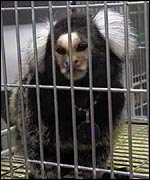
Marmosets occupy a place near the top of the evolutionary tree. These primates, genetically close to humans, are highly social. They make eye contact with each other and live in complex families. These territorial monkeys the size of squirrels are born to a life of frenetic, unfettered, movement. But it's also the fate of marmosets to be bred for laboratory research. Marmosets' brains are similar enough to those of people for them to be used as substitutes for humans in experiments. The experiments on these marmosets filmed at a British laboratory were carried out under a Home Office licence allowing "moderate suffering". Newsnight can show that the suffering of these animals was, in reality, substantial.
MICHELLE THEW:
I think we need to be honest the public about what these marmosets are enduring. We are talking about highly invasive brain research. Animals having their skulls open. Parts of their brains removed and being forced to endure very stressful testing proceeds
PROFESSOR DAVID MORTON:
They are showing deviation from normal behaviour. Their animal welfare is no where as good as it was before hand.
TONY BANKS:
What you are doing is alerting politicians to an abuse that has to be rectified.
PIGGOT:
The use of animals in research is regulated by the Home Office, which supports the rules as they exist. Brain diseases cause progressive disablement and death, and the Government maintains research on primates is vital if we are to find cures and treatments. Laboratories can carry out research projects on animals only after they have obtained a Home Office licence. Research projects are given licences which allow them to cause mild, moderate or substantial suffering to animals. The rules governing the allocation of a moderate licence seem to be drafted to include a broad range of experimental procedures. They include: many surgical procedures - provided that suffering is controlled and minimised by effective post-operative analgesia and care. Substantial licences include: protocols that may result in a major departure from the animal's usual state of health or well-being. These include surgery and some models of disease, where welfare may be seriously compromised. The guidance adds: if it's expected that even one animal would suffer substantial effects, the procedure would merit a "substantial" severity limit. In the light of public concern about testing on animals, Government figures on how much harm is done could be seen as reassuring. According to the Home Office only 2% of licences allow substantial suffering. More than 50% are in the moderate category. But secretly shot film shows experiments that cause substantial suffering are routinely carried out under a moderate licence. The Government says the public supports research on animals because of the potential benefits to science and medicine. But is that public backing based on a false assumption? It seems under current licensing, the true extent of suffering endured by laboratory animals is being systematically obscured. A volunteer belonging to the British Union for the Abolition of Vivisection worked under cover to investigate the fate of marmosets undergoing brain research. We've disguised the identity of the laboratory because, in the past, a violent minority of anti-vivisectionists have attacked scientists. To ensure the laboratory's anonymity we've also disguised the BUAV volunteer's identity. She worked for almost a year as a lab assistant, feeding marmosets and cleaning out their cages.
BUAV VOLUNTEER:
I've seen the marmosets who look like they can't see what is in front of their faces. They don't know what is happening to them. They can't possibly tell what is going on inside their heads. We had to give them the benefit of the doubt. I've seen marmosets who can't see in front of their eyes. Something straight in front of their eyes and they can't even see it. They look like their hallucinating. They are seeing something that isn't even there.
PIGGOT:
We showed her pictures to an independent expert. Professor David Morton is a vet and has held a research licence himself. He specialises in the study of suffering in animals. He did not think the experiments on the marmosets should have been covered by a moderate licence.
MORTON:
I think there is a case to place them in the substantial band, if you like, because these animals are showing major deviations, if you like, from normal behaviour. Their animal wellbeing is nowhere as near as good as it was before hand. It's not pain it's probably about mental distress. I think on that basis it should be in the substantial band.
PIGGOT:
The Government makes public whether overall research projects have a moderate or substantial license, but it keeps secret the degree of suffering allowed in individual experiments.
THEW:
It's only when we actually go behind-the-scenes in this sort of investigation that we really see what is happening. I believe that there be lots of instances where the Government is probably misapplying the law. In an instance like this if the Government can say this is moderate suffering we have to ask yourselves the questions about those experiments they categorise as substantial.
PIGGOT:
The organisation that defends the use of animals in experiments says British researchers are among the most tightly regulated in the world. They say the way suffering is classified is fair.
DR MARK MATFIELD:
It depends on who has been making the assessment of what is moderate and substantial. The way we do it in the UK is, independent home affairs officers make that assessment if you have presented with evidence from a vivisection group they have a vested interest in exaggerating it. If things have been wrongly categorised the Home Office should investigate.
PIGGOT:
There's no evidence the laboratory has broken the terms of the licences covering its experiments. Any pain or distress experienced by the marmosets is permitted under a moderate licence. However, the film shot by BUAV does raise concerns about the way animals are treated. Professor Morton expressed concern about one operation on a marmoset in which the animal seemed to be inadequately anaesthetised. The person monitoring the marmoset notices its legs tensing up but the operation on the animal's brain apparently continues.
FIRST UNNAMED DOCTOR:
Why are his legs pulled up?
SECOND UNNAMED DOCTOR:
Have you tried touching him? Is there resistance or are they floppy?
THIRD UNNAMED DOCTOR:
There's not resistance but there's a pull back.
FIRST DOCTOR:
So when you pull them they go back up again?
THIRD DOCTOR:
Yeah.
FIRST DOCTOR:
Give him another 0.2mls.
PIGGOT:
Although the surgeon suggests giving extra anaesthetic, Professor Morton says the operation should have been stopped at this stage. Professor Morton says too little is learned about how much animals suffer during experiments. That's because researchers are required to predict the effect of experiments on animals before they take place, but do not have to report how much pain or distress animals actually suffered. It helps to sustain a situation in which substantially painful or distressing experiments are carried out under moderate licences.
MORTON:
We've got substantial procedures being done to animals under a banding of moderate.
PIGGOT:
It's a scam, isn't it?
MORTON:
It could be called fudging the figures a little bit. A scam in that sense. It's one that we've really inherited with the way the Act has been worked.
PIGGOT:
Some researchers support more openness in describing the effect on animals of individual experiments, but many fear attack by extremists.
MATFIELD It has made people nervous about speaking out about animal research. We believe it's right we should speak out and explain to the public how animals are used in research and the research they are used for.
PIGGOT:
Medical research represents big business for the UK. Tony Blair insisted today that opponents on testing on animals should not be allowed to sabotage vital work.
TONY BLAIR:
The Government is at the forefront of pan European efforts to ensure there is no unnecessary duplication of animal experimentation. If we had stopped all animal experiments in recent years we would not have developed a meningitis vaccine or drug therapy for HIV injection
PIGGOT:
But this entrenched objection to animal testing could lead to scepticism about Government policy.
BANKS:
What you have produced is appalling. It confirms things that we knew and some of our suspicious as well. The legislation simply is not working effectively when it comes round to experimentation on primates. I really feel that we have to say is that there should be no experimentation, what so ever, on primates.
PIGGOT:
For the foreseeable future, with terrible diseases remaining unconquered animals are going to be used in research. But public support for vivisection and the expanding industry if fosters cannot rest on secure foundations.
This transcript was produced from the teletext subtitles that are generated live for Newsnight. It has been checked against the programme as broadcast, however Newsnight can accept no responsibility for any factual inaccuracies. We will be happy to correct serious errors.