|
 |
 | | | | | | ||||||||||||||||||||||||||||||||||||||||||||||||||||||||||||||||||||||||||||||||||||||||||||||||||||||||||||||||||||||||||||||||||||||||||||||||||||||||||||||||||||||
| | | You are in: Programmes: From Our Own Correspondent | ||||||||||||||||||||||||||||||||||||||||||||||||||||||||||||||||||||||||||||||||||||||||||||||||||||||||||||||||||||||||||||||||||||||||||||||||||||||||||||||||||||||||
|
| | Saturday, 26 October, 2002, 15:52 GMT 16:52 UK Bitter sweet evening in Kabul 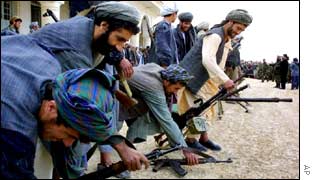 Men with guns still hold the casting vote in Afghanistan
It was the venue for an evening of spiritual music and - hopefully - dance. Myself and six male friends and four armed bodyguards were acutely aware of how lucky we were. The music we were about to hear is a riotous blend of South Asian and Middle Eastern instruments and vocals associated with a sect of Islam reputed to be moderate and tolerant - the Sufi sect. This performance, like any other musical event, would have been unthinkable under the Taleban. We had heard a lot about these Sufi music evenings. Sufi music We had heard that the music was of the highest quality and that some of the audience would enter into a trance, some would dance and sing with the performers. It is a form of spirituality frowned upon by the rest of Islam and so all the more astonishing for the vigour with which it has returned to Kabul.
That would have meant returning during the curfew which locks Kabul's residents indoors from midnight to 0400 every day. And so we needed the crucial password - which you whisper to soldiers at roadblocks so they permit you to pass. A good-natured army officer said he couldn't possibly tell me the password but he could certainly send some men with us who knew it. Head scarf The venue didn't look like much - it was a two-storey house with a cavernous hole in the centre, possibly created by a bomb. But enough of it remained for about 100 people to sit tightly packed, listening to the performers sitting on a gaudily lit stage. We arrived after the performance had started but that is normal in this part of the world, so we were greeted warmly at the door by several young men.
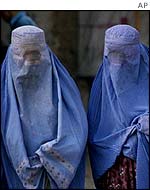
Neither of them were at all convinced that I really needed to cover my head, but said I should do so just in case. Soon, I was picking my way through rows of men seated on the floor to the front of the room. We sat down on the carpet to the strains of the traditional Afghan rubab instrument. Although several men in the audience had looked up and stared as we filed into the room, we didn't think we had made much of an impact on the performers. We were wrong. A man walked over to us, leaned over to one of my Afghan friends and said something in his ear. Soon my other Afghan friend and two bodyguards were also involved in a whispered discussion while the music continued. Tense debate "What's the problem?" I asked my friend. "Er... you're the problem," my friend said apologetically. "They say they can't play with a woman in the room." I was astonished. I had spoken to several people about the Sufi music evening I was due to attend, and not one, not even a well-known Sufi religious leader, had said women could not attend. It was clear I was the only woman at the performance - but in Afghanistan, foreign women often find that they are the only women in public places. While we debated what to do, my heart sank as I realised the music had stopped and members of the audience had started walking out. I was horrified at the scene I had inadvertently created. We noticed that only one rather elderly musician had taken exception to my presence - the others were quite happy to let me stay. When my friends ask me what the status of women is in Afghanistan it is hard to know what to say. You have men - and perhaps some women - like this man, who believe a woman makes a holy environment impure. On the other hand you have men like my two bodyguards and my Afghan friends who used the break in the music to lecture the musicians on women's rights. My soldier bodyguard stood tall and shouted that men and women walk side by side during the Islamic pilgrimage the Haj at Islam's holiest city Mecca - how could women possibly corrupt a holy atmosphere? Low profile My Afghan friend said: "She's a journalist, she's recording the culture and history of Afghanistan, and if a woman does that kind of work, is this the thanks that we should give her?" I kept a low profile, interested in the spectacle of men arguing over a woman's right to stay. I wondered who would win the argument - the religious conservative or the man with the gun. Eventually, in the best traditions of cultural conflict and diplomacy, a compromise was reached. My party ended up sitting on the roof terrace adjacent to the room, so close to the stage that we had a far better view from there than we would have had from sitting in the room. This was enough to maintain the illusion that a woman was not in the room. As we stepped over a low window sill to get the roof, one of the musicians put a warm coat over my shoulders. I think it was his way of apologising, of making up for the hostile reception I had received from one of his colleagues. The rest of the evening was magical, with many of our hosts eager to compensate for the ugly start by plying us with green tea and food. The music and audience lived up to our expectations and we left during the curfew, with our friends from the army. And we even got the password. | |
See also:  09 Dec 01 | South Asia Internet links: The BBC is not responsible for the content of external internet sites Top From Our Own Correspondent stories now: Links to more From Our Own Correspondent stories are at the foot of the page. | ||||||||||||||||||||||||||||||||||||||||||||||||||||||||||||||||||||||||||||||||||||||||||||||||||||||||||||||||||||||||||||||||||||||||||||||||||||||||||||||||||||||
| |
|  E-mail this story to a friend E-mail this story to a friend |
|  |
| Links to more From Our Own Correspondent stories |
| | | ||
 | ||||
 | | Back to top
| ||
| ---------------------------------------------------------------------------------- To BBC Sport>> | To BBC Weather>> | To BBC World Service>> ---------------------------------------------------------------------------------- © MMIII | News Sources | Privacy |