|
 |
 | | | | | | |||||||||||||||||||||||||||||||||||||||||||||||||||||||||||||||||||||||||||||||||||||||||||||||||||||||||||||||||||||||||||||||||||||||||||||||||||||||||||||||||||
| | | You are in: Programmes: From Our Own Correspondent | |||||||||||||||||||||||||||||||||||||||||||||||||||||||||||||||||||||||||||||||||||||||||||||||||||||||||||||||||||||||||||||||||||||||||||||||||||||||||||||||||||||
|
| | Saturday, 5 October, 2002, 12:37 GMT 13:37 UK Sparks fly at Milosevic grand slam 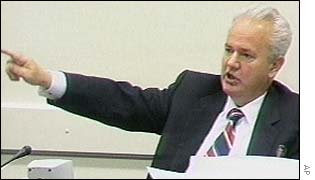 Insults fizzed back and forth across the court
The three judges file in, they bow, and we all sit down again. Some things at this tribunal do conform to legal tradition - but not many. For one thing, it's not every day that a former head of state is on trial for genocide. This is an ongoing experiment in international justice. In many ways it is uncharted waters - we've not been here before.
On one side of me were Croatian journalists, laughing dismissively at suggestions from the accused that he's been terribly misunderstood. "I was a man of peace", he said, and they snorted at their notebooks. Sitting on my other side was a group of Milosevic loyalists from Belgrade. They didn't like the laughter. They scowled in our direction, and then turned to smile at their man. Through the glass wall, which separates the public gallery from the rest of the court room, he raised a quizzical eyebrow. Ohio remembered Slobodan Milosevic is always immaculately turned out. His face utterly familiar, his hair a little whiter, his suits as sharp as his tongue. The last time I sat in the same room as him was seven years ago at a US airforce base in Dayton Ohio. Under American pressure he signed the agreement which brought peace to Bosnia, peace at the price of ethnic division.
Now he divides his time in The Hague between prison and court room. His world has shrunk dramatically, but he still has an eye on a wider audience. He believes he's the fall guy - set up by the duplicitous West, in league with Croatian fascists and Muslim fundamentalists. In court, he taps his foot impatiently. He smirks and frowns; he flicks through piles of paper. A loudspeaker has been put right in front of him - forcing him to listen whether he likes it or not, as the entire proceedings are translated into Serbian. I say Serbian without wishing to offend anyone. Channel six on the court's internal translation system is labelled Serbian or Croatian or Bosnian. You take your pick, but no-one calls it Serbo-Croat any more. Some wounds will not be healed. But the names are the same - Srebrenica and Sarajevo, Vukovar and Dubrovnik - surely war crimes in any language. But who was really responsible, can the prosecution prove that the man from Belgrade should take the blame?
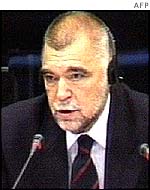
And Slobodan Milosevic defends himself. His main tactic: to blame everyone else, and that means the sparks tend to fly fairly regularly. None more so than when Mr Milosevic came face to face with an old political enemy. The current President of Croatia Stipe Mesic was testifying against him. You could have cut the atmosphere with a knife. Umpiring an age-old conflict The trial chamber is known as Court Number One, but it felt more like Centre Court, having a front row seat at a Grand Slam final. Insults fizzed back and forth across the room like Sampras and Agassi pounding a tennis ball.
The umpire in this and other matters is the presiding judge Richard May from Britain - a man with a heavy weight of responsibility on his shoulders. Before he joined the tribunal, he was a circuit judge in Oxford, but now he's knee-deep in the bitter web of Balkan history. And Mr Milosevic and Mr Mesic were both giving as good as they got. The judge snapped. "The trial chamber is not assisted", he said, "by the exchange of abuse. Especially abuse from 100 years ago". But that only seemed to spur Slobodan Milosevic to greater heights - and soon the judge was back. "Mr Milosevic," he sighed. "You must understand that attacking others is not a form of defence". His words hung awkwardly in the air. If only someone had told that to the man from Belgrade a decade ago. And to his counterparts in Zagreb and Sarajevo. Maybe we wouldn't be sitting here now, in the Hague, staring through a glass wall into a world of smoke and mirrors. | |
See also:  02 Oct 02 | Europe 02 Oct 02 | Europe 02 Oct 02 | Media reports 01 Oct 02 | Europe 26 Sep 02 | Europe 23 Sep 02 | Europe 10 Dec 01 | Europe Internet links: The BBC is not responsible for the content of external internet sites Top From Our Own Correspondent stories now: Links to more From Our Own Correspondent stories are at the foot of the page. | |||||||||||||||||||||||||||||||||||||||||||||||||||||||||||||||||||||||||||||||||||||||||||||||||||||||||||||||||||||||||||||||||||||||||||||||||||||||||||||||||||
| |
|  E-mail this story to a friend E-mail this story to a friend |
|  |
| Links to more From Our Own Correspondent stories |
| | | ||
 | ||||
 | | Back to top
| ||
| ---------------------------------------------------------------------------------- To BBC Sport>> | To BBC Weather>> | To BBC World Service>> ---------------------------------------------------------------------------------- © MMIII | News Sources | Privacy |