|
 |
 | | | | | | ||||||||||||||||||||||||||||||||||||||||||||||||||||||||||||||||||||||||||||||||||||||||||||||||||||||||||||||||||||||||||||||||||||||||||||||||
| | | You are in: Programmes: From Our Own Correspondent | ||||||||||||||||||||||||||||||||||||||||||||||||||||||||||||||||||||||||||||||||||||||||||||||||||||||||||||||||||||||||||||||||||||||||||||||||||
|
| | Saturday, 31 August, 2002, 14:21 GMT 15:21 UK Car crazy America reluctant to change 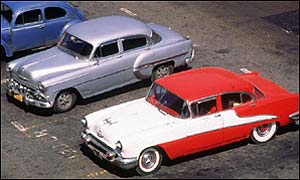 America has a long-standing love of large cars
The Island Packet - the daily newspaper of Beaufort county, south Carolina - has a big story on the front page. There in black and white - is the shocking revelation that Beaufort county planners have been meeting to discuss a regional transportation system.
The paper explains what this is - it would link the county to outlying areas including the nearby city of Savannah, Georgia and the holiday resort of Hilton Head. People wouldn't have to use their cars. But outraged residents want to use their cars - and they fear the kind of people who use public transport just would not fit in these parts. "We're not that kind of community", one of them is quoted as saying - and that is the rub. 'Car-driving society' America is not that kind of community. It is a car-driving society - not in an easy going, take-it-or-leave-it "oh we'll try something else" sense, but in a profound, almost religious way. The right to drive is a deeply valued blessing - and one that will not be given up lightly, in fact will not be given up at all.
There are environmentally aware Americans - they mostly wear beads and live in Seattle. The rest of the nation drives past them hardly noticing their presence. When I say the nation drives past them - I really mean the nation. One of the most striking things about living in America is the automotive energy of the place. Everyone is driving. I was somewhere in North Carolina recently on route 95, the road that curves thousands of miles from the southern tip of the nation in Florida up to the north-east border with Canada. Route 95 is a motorway served by thousands of pit-stop communities along the way - little agglomerations of cheap restaurants, garages and hotels that sprawl in gaudy fume-laden oases at strategic turnoffs. The bigger ones have everything - McDonalds, Burger King, Hardees, Dunkin' Donuts, Kentucky Fried Chicken - and the best of them have a chain called Cracker Barrel which serves quite pleasant food. Here you tend to find the savvy long-distance brigade - this being America there are rich and poor and everything in between all eating together. But what they have in common is miles under their belts. At a Cracker Barrel somewhere on route 95 I met a granny and her two grandchildren who'd been staying with her in northern Florida. She was taking them home to Wichita, Kansas. This is a journey of 1,000 miles and they do it several times a year. No alternative There is no alternative to driving. To fly would be hugely expensive - there is no train, and long distance bus travel is grim. Of course there is something that would keep ordinary Americans off the road and would keep that granny from her grandchildren at least a few times a year - a hike in the price of petrol.
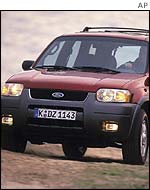
But petrol here is still much cheaper than mineral water - under $1.50 a gallon. Americans, by the way, still use gallons - the litre is a measure too small to be of interest here. Any attempt to raise the fuel price with taxes would almost certainly lead to a revolution. Particularly since 11 September, Americans have been feasting themselves on new cars. An orgy of comfort buying brought on by fear of flying but also by a desire to be close to loved ones. If you are going to spend more time in your car you're going to want it to be more comfortable. American cars - after a lean decade or two are getting bigger again. Sadly those cruising monsters with tailfins and chrome from the 1950s are dead forever, but instead of being wide modern American cars are tall. Driving in Mobile, Alabama a few days ago I stopped at some traffic lights and thought I'd take a chance to inspect my fellow motorists. Alas I couldn't. I was driving a compact car - that means normal size - everyone around me on both sides appeared to be driving tanks. All I could see was bumpers and paintwork. Environmental ignorance In the hotel in Mobile I saw on American television a mention of the development summit and a discussion about the plight of the Maldives - that gorgeous island archipelago which we are told is threatened with inundation as sea levels rise. When I say a discussion - well it wasn't quite that - by the time they had worked out where they were and marvelled at how small they were there was no time to talk about saving the islands. Do Americans know that the rest of the world is ganging up on them again and accusing them of polluting the planet? - yes vaguely. Do they care? Not much. Environmentalism is part science, but let's face it it's also part religion - dependant on faith not proven fact. Here in the land of the Sports Utility Vehicle - they worship different gods. | | See also:  30 Aug 02 | Americas 18 May 01 | Business Top From Our Own Correspondent stories now: Links to more From Our Own Correspondent stories are at the foot of the page. | ||||||||||||||||||||||||||||||||||||||||||||||||||||||||||||||||||||||||||||||||||||||||||||||||||||||||||||||||||||||||||||||||||||||||||||||||
| |
|  E-mail this story to a friend E-mail this story to a friend |
|  |
| Links to more From Our Own Correspondent stories |
| | | ||
 | ||||
 | | Back to top
| ||
| ---------------------------------------------------------------------------------- To BBC Sport>> | To BBC Weather>> | To BBC World Service>> ---------------------------------------------------------------------------------- © MMIII | News Sources | Privacy |