|
 |
 | | | | | | ||||||||||||||||||||||||||||||||||||||||||||||||||||||||||||||||||||||||||||||||||||||||||||||||||||||||||||||||||||||||||||||||||||||||||||||||
| | | You are in: Programmes: From Our Own Correspondent | ||||||||||||||||||||||||||||||||||||||||||||||||||||||||||||||||||||||||||||||||||||||||||||||||||||||||||||||||||||||||||||||||||||||||||||||||||
|
| | Sunday, 28 July, 2002, 00:38 GMT 01:38 UK China's changing face 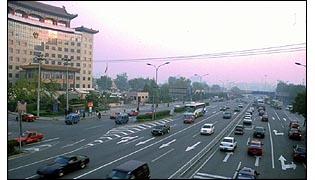 Many cities - like Beijing - have modernised radically
The rapid pace of China's economic development has changed its physical landscape out of all recognition. Nowhere is this felt more than in the major cities, where historic buildings have been razed to the ground to make way for flashy modern developments. The destruction of the old hutongs or lanes of Beijing has attracted international attention, but it's not the only place to have been transformed. Eight years ago, I lived in the Sichuanese capital, Chengdu, and knew it intimately. But these days I'm not sure if it is the same place at all. Picture a bustling street market lined with potted plants and tubs of goldfish, cyclists weaving among the stalls and shoppers. In the middle, somewhat hidden, is a narrow entrance. Beyond it lies the Lanyuan, the Orchid Garden teahouse. In the dim light of the old timber-framed building, the customers sip from their bowls of jasmine tea as they play cards or scan the newspapers. The air twitters with the sound of songbirds, suspended in cages from a bamboo pole. And near the entrance their owners, a group of old men dressed in blue, draw on long bamboo pipes as they chat to while away the afternoon. Rapid changes A decade ago, there were hundreds of small neighbourhood teahouses like the Lanyuan. Some were centres of Mah Jong or the game of Chinese chess, others put on shows of Sichuan opera. Tucked away in courtyards or spilling out onto narrow streets, they were centres of their surrounding communities. But as Sichuan hurtles forth on its programme of modernisation, they have almost all been demolished, their customers relocated to apartment blocks on the outskirts of town. The giddy pace of development has made revisiting Chengdu almost surreal. Every time I go back I am faced with the yawning absence of familiar landmarks: teahouses, street markets, noodle shops and whole networks of narrow, winding lanes.
With them have gone familiar faces and traditional crafts: street-vendors who sold leaf-wrapped dumplings from steamers propped on the back of their bicycles, elderly shoemakers who stitched cotton slippers on the thresholds of their homes. It is hardly an exaggeration to say that the whole city has been destroyed and built anew within the last eight years. With the old city has gone much of Chengdu's charm and character. Not only the ramshackle Sichuanese houses, with their woven panels, wooden frames and whitewash, but also buildings of more unique historical significance. The most notable was the Imperial City Mosque, a lovely complex of single-storey buildings and leafy courtyards which had stood in the city centre for more than three centuries until it was torn down four years ago. Embracing modernity Even the old Manchu and Mongol section of Chengdu, which is marked on maps as a conservation area, has been partially demolished. Wide streets and tiled skyscrapers of little architectural interest have taken over the city, making it almost indistinguishable from any other in China. Most local residents are pleased with the changes. They point out that the old houses were damp and draughty in winter, oppressively hot in summer. The new apartment blocks are cleaner, more private and more comfortable. Many people are impressed with the ostentatious modernity of the new Chengdu, which they see as evidence that Sichuan is shaking off its economic backwardness.
The only people who mourn the wholesale destruction seem to be a few artists, writers and intellectuals. But even they regard it as inevitable. "It's just part of the process of development," says Yang Yali, an entrepreneur and art collector who is passionate about Sichuan and its cultural traditions. "Now people want material progress, but in a few years they'll recognise the value of their history". She just smiles and shrugs her shoulders when I point out that by the time this happens, there'll be nothing left. For a foreigner like me, from a culture which values its heritage, it is hard to understand this ruthless Chinese pragmatism. Demolition teams On every recent visit to Chengdu I've wandered forlornly through the latest area marked for demolition. I've said goodbye to restaurants where I studied Sichuanese cookery, countless teahouses, the stall where I used to sit and chat with roast duck vendor Mr Liu, as he plied me with jars of spicy bean curd. It has felt more and more like a post-mortem of this city that I've loved. But as old Chengdu has dwindled around it, the Lanyuan teahouse has somehow defied all odds and continued to exist, quietly defiant in its seclusion. Every year I've rediscovered it with relief and gratitude, an oasis of calm in an increasingly frenetic urban landscape. I have picked my way among the plant-sellers in the market with bated breath, looking out for the hidden entrance, hoping against hope that it should still be there. And each time, I've found the old men sitting over their tea as they always have done, the laconic owner filling tea bowls from his kettle and stopping for a chat. This spring the Chengdu authorities announced their decision to speed up the demolition work, and the few old streets that remain are undergoing a swift and merciless dismemberment. As I go on my usual mission in search of the Lanyuan teahouse, my heart leaps and sinks by turns. I find nearby buildings missing or half-destroyed, gaping like cadavers, but the flower market is still there - a promising sign. But this time, the teahouse has really gone. I slip through the hidden entrance to be confronted by a vast plain of rubble. A few broken bamboo chairs and a battered wooden table lie where the old men used to sit. Nearby there's a random scattering of tea bowls covered in the grey dust of demolition. All that remains of my favourite teahouse is one skeletal interior wall, pasted with four familiar Chinese characters, a quote from the great third century statesman Zhugeliang: ning jing zhi yuan - far sightedness comes from a peaceful mind. | | See also:  28 Jun 02 | Asia-Pacific 22 Jul 01 | From Our Own Correspondent 20 Jan 01 | From Our Own Correspondent Internet links: The BBC is not responsible for the content of external internet sites Top From Our Own Correspondent stories now: Links to more From Our Own Correspondent stories are at the foot of the page. | ||||||||||||||||||||||||||||||||||||||||||||||||||||||||||||||||||||||||||||||||||||||||||||||||||||||||||||||||||||||||||||||||||||||||||||||||
| |
|  E-mail this story to a friend E-mail this story to a friend |
|  |
| Links to more From Our Own Correspondent stories |
| | | ||
 | ||||
 | | Back to top
| ||
| ---------------------------------------------------------------------------------- To BBC Sport>> | To BBC Weather>> | To BBC World Service>> ---------------------------------------------------------------------------------- © MMIII | News Sources | Privacy |