
|
 |
 | | | | | ||||||||||||||
| | You are in: World: From Our Own Correspondent | ||||||||||||||||
 | | Thursday, 28 March, 2002, 13:53 GMT Peru's famous yarn 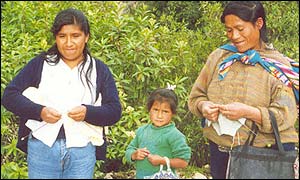
I blame Bin Laden. If it wasn't for him and his followers then I would still be able to ease the boredom of long-haul flights with my favourite companion - my knitting. And don't think that I could get round airline restrictions by taking plastic rather than metal needles. As any knitter knows - using plastic is about as easy as riding a skateboard without wheels. And to arrive without my knitting in Peru, where so many women are at it is like arriving naked at a knitting convention.
In the markets, in the streets, on the buses, in the fields - and of course at home - deft, quick, stitch by stitch, the country's clothed - or jumpered. De-railed but still knitting Travelling by train in the central mountains, there's a sudden jolt and a terrible grating sound. The last coach has de-railed. From my window, I watch as a work-gang is summoned from houses along the track to place boulders under the carriage and lever the wheels. Eventually, the shouting and shunting back and forth achieves the desired effect and we are back on track. I measure how long this takes by watching for the clicking needles of two onlookers standing on a mound of earth. Thirty rows of a dainty, cabled, blue front-side of a cardigan and about three centimetres onto a hot-pink jumper for a child, and we are away. Up in the mountains, walking between villages enveloped by cloud, I come across a woman watching her flock of wether lambs. She wears the traditional fine-woven, huge-brimmed hat and her gathered black skirt sways as she guides the sheep through the pasture in a circuit back to the village for the night. She is suckling her infant at her breast and - of course knitting. How's that for multi-tasking? Professionals For some women in Peru, knitting is a living. In a suburb of the capital, Lima, in an upstairs room, I meet some of the country's professional knitters.
No machine can yet match their skill. Four master craftswomen are working on incredibly intricate jackets, jumpers and waistcoats destined to grace the shoulders - and impress the friends - of affluent women in Europe and North America. Every garment is unique. Shy and understandably suspicious of my questions about their lives, it was my genuine appreciation of the skills at these fingertips that breaks the nervous tension between us. Not only is knitting these women's living, it's an escape. Fifty-seven year old Anatolia, her complexion etched with years of worry, looks up from the delicate pima cotton jacket taking shape on her lap. She tells me that she knits eight hours in the day and three or four more in the evening, if she can, as she needs the money. "But to knit this is extraordinarily difficult," I say, "if you feel tense or unhappy surely it will show?". Furtive knitters She doesn't take her eyes away from mine as she waits for the translation and then her face breaks into a smile. "I set all my troubles aside. I escape from them when I knit. That's the secret." In truth, some women have to knit in secret.
Their relationship with their partner is such that if he was to discover her new income, he would stop giving her any of his towards household expenses. So the women lie about where they are going. Saying they are going to a meeting or to visit a sick friend, they sneak away for a few hours at work at their needles in a safe house. Some partners reluctantly accept the constant gentle click, click, click. Twenty-seven year-old Margarita is working on another equally complex creation. "My husband tells me I pay more attention to my knitting than either him or our children. But the only work he has is washing cars in the street. He can be days without money. My knitting gives us everything we have." One evening in the north, in the region of Cajamarca, the clouds roll back up the high pine-forested sides of deep valleys.
Below in the crazy-paved grazing, studded with farmsteads, gentle cows stand in the meadows for the evening's hand-milking. It's the speed and sound of the river that holds my attention, so I didn't see the others coming towards me along the same path. A grandmother, her daughter and her young child are all knitting as they walk. We greet and exchange queries about where we're heading. But it was the little girl's two rows of unsteady stitches that remind me I'd learned to knit from my grandmother too. I was invited to join them as they sat at the riverside. After days of research and interviews, this time I felt no need to ask more questions. It was enough to sit in silence together, sharing what we had in common. | | See also:  Top From Our Own Correspondent stories now:  Links to more From Our Own Correspondent stories are at the foot of the page. | ||||||||||||||
|
Links to more From Our Own Correspondent stories |
 | | ^^ Back to top News Front Page | World | UK | UK Politics | Business | Sci/Tech | Health | Education | Entertainment | Talking Point | In Depth | AudioVideo ---------------------------------------------------------------------------------- To BBC Sport>> | To BBC Weather>> ---------------------------------------------------------------------------------- © MMIII|News Sources|Privacy  |


 E-mail this story to a friend