|
 |
 | | | | | | |||||||||||||||||||||||||||||||||||||||||||||||||||||||||||||||||||||||||||||||||||||||||||||||||||||||||||||||||||||||||||||||||||||||||||||||||||||||||
| | | You are in: Programmes: 4x4 Reports | |||||||||||||||||||||||||||||||||||||||||||||||||||||||||||||||||||||||||||||||||||||||||||||||||||||||||||||||||||||||||||||||||||||||||||||||||||||||||||
|
| | Monday, 15 July, 2002, 17:36 GMT 18:36 UK Mixed messages 'increase pregnancy and disease'  A third of girls in the UK have sex by their 16th birthday
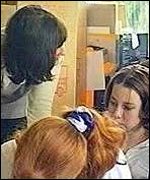
It is a telling classroom exercise. Six teenagers each drink from a cup of water which represents the bodily fluids exchanged during intercourse. Tara Wood, the teacher, a member of an American project called KISSN, Keep it Simple Say No, then directs them to spit into their own cup and pass it on to two partners. "Who did you exchange it with? Who were you with second?" Wood tests. No one has a clue. "That," she says, "is how sexually transmitted diseases spread. The only safe sex is no sex."
"I don't want to be the next person on somebody's list," she explains. "I want to be the first." This is the abstinence movement in the USA, whose most celebrated cheerleader was, before a recent 'has she, hasn't she?' controversy, the singer Britney Spears. The KISSN scheme features in Sex Lessons, tonight's programme in BBC 1's current affairs series, 4x4 Reports, which examines the issues raised by the twin dilemmas of Britain's phenomenal rate of teenage pregnancy and the massive increase in sexually transmitted diseases in the young. In seven years, rates of chlamydia - a disease which can cause infertility - have increased by 107%, while gonorrhoea has increased by 102%. Sex sells "Sexual health clinics are overflowing," says Dr Mark Pakianathan, of the Town Sexual Health Clinic in Enfield. But is abstinence a realistic goal? We live in a society which wraps sex around every product, from cat food to double glazing. Persuading teenagers to "just say no" is an almost impossible task and one that may do more harm than good if it leaves young people unprepared for the harsh realities of life. British teenagers live in a culture of mixed messages. Sex is taboo, yet it is everywhere. As a result, our rate of teenage pregnancy, which in the '70s was in step with the rest of Europe, is now three times higher than France, and six times the figure in the Netherlands. In the UK, 90,000 teenagers annually become pregnant, of whom 7,700 are under 16. Research by the American Guttmacher Institute shows that countries which publicly and privately accept the right for teenagers to be sexually active and offer advice and healthcare have much lower rates of pregnancy and patterns of multiple partners. 'Macho drive' A more realistic approach is to encourage teenagers to delay their first experience of sex for as long as possible, to use contraception and exercise discrimination so sex is not what automatically happens after a couple of alcopops with a lad who asks nicely - or one who does not. Among the more tragic statistics to emerge is that 70% of girls who had sex under the age of 16 regret their first experience while one in five complains of physical coercion. Studies indicate girls are unhappy that sex education concentrates on the mechanics rather than the complexities of relationships.
Boys claim the information they are given is not explicit enough and there is very little to counter the macho drive to "do it" as a way of acquiring the kudos of being an alpha male. Dr Lynda Measor, who carried out one of the studies, explains that young males receive most of their knowledge from ponography and peers. Teenagers say they prefer information to come from their parents. When parents do talk to their offspring, research indicates the children are more likely to delay intercourse and use contraception. Premature motherhood Except that, in Britain, reared on a diet of nudge, nudge, wink, wink, many parents are too embarrassed and expect school to fill the gap. In the classroom, however, according to a recent report by Ofsted, the education watchdog, sex education is basic and guidance on relationships, parenthood and sexual health poor. Ofsted also points out that the problem in Britain is also the quality of the relationships between young people. In the Netherlands, for instance, 55% of boys say that their first sexual encounter is the result of love and commitment. In Britain, the figure is only 15%. Much is amiss but what is to be done? After coming to power, Labour commissioned the Social Exclusion Unit to propose a strategy. The unit's report, Teenage Pregnancy, published in 1999, starkly lays out the long-term impact of premature motherhood on individuals and the taxpayer. By the age of 33, teenage mothers are likely to be divorced and living on benefits without qualifications. Babies born to a teenage mother experience a death rate that is 60% higher than the norm. Government targets Experience tells us that the best form of contraception is aspiration. Two-thirds of girls remain virgins until they are 16. The remaining third who do not and conceive are more likely to be poor and play truant. They have babies because motherhood offers a role in a life that is otherwise rudderless. The government's target is to cut the teenage pregancy rate by 15% in 2004 and 50% by 2010; to improve sex education and access to contraception and to encourage parents, particularly in education. So how successful has the strategy been so far? Teenage conception rates overall have fallen by two per cent but sex education continues to suffer. Ministers are shackled by their own timidity so, for instance, school governors can refuse to allow sex education and as a result 10% of primary schools have none. Peer pressure Pupils whose parents are embarrassed to broach the subject are left in ignorance or to pick up what they can from playground gossip. Government plans to allow contraception in school clinics are attacked by critics who claim this will recruit still greater numbers to the path of promiscuity. Ignorance, they insist, is bliss. Tell that to 11 and 12-year-olds who are becoming pregnant when they barely know the facts of life. There is no point believing that, if parents and schools refuse to discuss sex, children will remain in a state of childlike innocence. On the contrary, they are subjected to a constant drip feed of sexual imagery from TV, increasingly watched unsupervised by parents. By refusing children vital information we are putting them at risk of pregnancy and disease. 'Sexual supermarket' The job of spreading the plain, grim truth - that premature motherhood is tough and multiple partners are bad for health - is often left to innovatory projects such as the Girls Friendly Society Young Women's Project in Great Yarmouth, which sends out a team of teenage mothers to talk to pupils. As we strive to stem the tide of teenage pregnancy we should follow the example of the Netherlands, where the core message in relationship education is respect for oneself and others. The challenge facing government, teachers and parents alike is discovering how to develop self-esteem in our children. Then they may have at least a chance of visualising a future beyond the sexual supermarket which is teenage life today. 4x4 Reports: Sex lessons was on BBC 1 at 1930 BST on Monday 15 July and streamed live from this website. | |
See also:  14 Jul 02 | Health 14 Feb 01 | Health 30 Nov 01 | Health 24 Oct 00 | Health 27 Jul 01 | Health 30 Nov 01 | Health Internet links: The BBC is not responsible for the content of external internet sites | |||||||||||||||||||||||||||||||||||||||||||||||||||||||||||||||||||||||||||||||||||||||||||||||||||||||||||||||||||||||||||||||||||||||||||||||||||||||||
| |
|  E-mail this story to a friend E-mail this story to a friend |
| |
| Links to more 4x4 Reports stories |
| | | ||
 | ||||
 | | Back to top
| ||
| ---------------------------------------------------------------------------------- To BBC Sport>> | To BBC Weather>> | To BBC World Service>> ---------------------------------------------------------------------------------- © MMIII | News Sources | Privacy |