
 low graphics version | feedback | help

|
 |
 The BBC's Hilary Andersson reports The BBC's Hilary Andersson reports"Negotiators sit down for their second day of talks"  real 28k real 28k |
Israel hints at Jerusalem compromise
 Jerusalem's religious sites will be at the centre of the negotiations Jerusalem's religious sites will be at the centre of the negotiations |
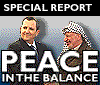
As Israeli and Palestinian negotiators embarked on a second day of peace talks, it has emerged that Israel may be prepared to make concessions on one of the most bitterly contested issues - the status of Jerusalem.
Israel regards the city as its eternal and undivided capital, but a deputy defence minister, Ephraim Sneh, indicated in an Israeli televison interview, that the government could agree to "share" a united Jerusalem.
 |
The highly controversial plan would almost certainly be seen among right-wing Israelis as a sell-out.
| Sticking points |
 | Jerusalem |
| Jewish settlements |
| Palestinian refugees |
| Final borders |
And a member of the Palestinian cabinet has already rejected the proposal as unacceptable.
Palestinian minister of non-governmental organisations Hasan Asfur said in a television interview that Israel clearly wanted to maintain its own sovereignty over the whole city, in defiance of international opinion.
Meanwhile, in Moscow, international representatives have begun informal contacts ahead of multilateral talks on the Middle East.
Foreign ministers from the Middle East, western Europe, East Asia, Canada and the United States are due to meet on Tuesday.
Religious sites
Mr Sneh set out his proposal for the future of Jerusalem in an interview with Israeli television.
He said the city's municipal boundaries could be expanded to accommodate Palestinian aspirations for a presence in the city.
Palestinian minister of non-governmental organisations Hasan Asfur said in a television interview that Israel clearly wanted to maintain its own sovereignty over the whole city, in defiance of international opinion.
Meanwhile, in Moscow, international representatives have begun informal contacts ahead of multilateral talks on the Middle East.
Foreign ministers from the Middle East, western Europe, East Asia, Canada and the United States are due to meet on Tuesday.
Religious sites
Mr Sneh set out his proposal for the future of Jerusalem in an interview with Israeli television.
He said the city's municipal boundaries could be expanded to accommodate Palestinian aspirations for a presence in the city.
 Arafat and Barak: Expected to meet midweek Arafat and Barak: Expected to meet midweek |
He also said that, on the religious level, special status could be given to holy sites.
The BBC Jerusalem correspondent Hilary Andersson says expanding the boundaries would ensure that the government looked like it was sticking to its election pledge to keep Jerusalem as Israel's eternal and undivided capital.
The majority of Palestinians who live in Jerusalem reside in the east. Others live in areas that are not classified as Jerusalem, but which are near the old city and its holy sites.
Talks gain momentum
Representatives from both sides held their first session of talks at a secret location near Jerusalem on Sunday - the first of 10 days of talks intended to forge a framework deal by 13 February. That, in turn, is supposed to lead to a permanent settlement by September.
Israeli Prime Minister Ehud Barak said that he was committed to sincere negotiations with the Palestinians as well as the Syrians, and had no intention of playing one against the other.
"Ten days from now we are going to convey another piece of territory to the Palestinians," Mr Barak said, adding that he expected the Palestinians to "honour their commitments."
Delays
Talks between Israel and the Palestinians over relatively simple issues, such as a land handover scheduled for mid-January, have proved complex and caused delays.
The Palestinians are currently waiting for the interim handover of another 6.1% of West Bank land from the Israelis.
But it is the future of the 60% still occupied by Israel and the sovereignty of Jerusalem that provide the real obstacles in the talks.
Other issues, such as the demarcation of final borders, the fate of Palestinian refugees, water rights and the future of Jewish settlements on occupied land have seen equally little progress.
| Search BBC News Online | |
|  Advanced search options | |
| |
 | |
 | |
| |
 | BBC RADIO NEWS |
| |
| |
| BBC ONE TV NEWS |
| |
| |
| WORLD NEWS SUMMARY |
| |
| |
| |
| |
| PROGRAMMES GUIDE |

 Country profiles
 | |
See also: | |
| |
 | 08 Nov 99 | Middle East |
| Hurdles remain for Mid-East peace |
| |
| 24 Jan 00 | Middle East |
| Final status schedule slipping |
| |
| 29 Jan 00 | Middle East |
| Arafat and Barak meeting 'next week' |
| |
| 20 Jan 00 | Middle East |
| Clinton: Mid-East compromise inevitable |
| |
| 18 Jan 00 | Middle East |
| US struggles to sustain peace process |
| |
| 18 Jan 00 | Middle East |
| Barak turns to Palestinians |
| |
| 11 Jan 00 | Middle East |
| Analysis: The 'roadmap' to peace |
| |
| 05 Jan 00 | Middle East |
| Analysis: Land, arms and security |
| |
| |
Internet links: | |
| |
| Government of Israel |
| |
| Palestinian National Authority |
| |
The BBC is not responsible for the content of external internet sites | |
Links to other Middle East stories are at the foot of the page.
 E-mail this story to a friend

