By Martin Asser
BBC News, al-Khiyam, southern Lebanon |

Al-Khiyam lies on a ridge running due north from the Israeli-Lebanese border.
 | Residents start rebuilding their lives in al-Khiyam 
|
To the west, on a parallel ridge are the Lebanese Christian towns of Marjayoun and Qleia, with a lush valley of fruit farms and tobacco plantations in between.
To the east looms the high mountain range which includes the Shebaa Farms, an-Israeli occupied part of Syria, with army outposts dotted along the top, keeping an eye on the surrounding area.
To the south is Israel - whose nearest settlement is Metulla, built defiantly on the northern side of a cone-shaped hill topped with antennae, right next to the border.
Al-Khiyam itself has a population of 15,000 inhabitants, the large majority of them Shia Muslims, although there are also some Orthodox and Maronite Christians.
The town was known for being one of the few mixed Christian-Muslim areas in south Lebanon, but the demographic balance has been tipping towards Shia Muslims in the last 25 years.
Lots of inhabitants left al-Khiyam when Israel occupied the area in 1978 and again in 1982, but while Shia Muslims returned, many of the Christians did not.
There are reckoned to be about 20 Christian families still present in the town - although that was before the recent conflict with Israel, which resulted in widespread damage to houses of both Christians and Muslims.
Basic needs
Israel's bombardment of south Lebanon, following the capture of two soldiers in Israel by the Lebanese militant group Hezbollah, has been catastrophic for the town.
Whole areas were turned to rubble by aerial bombing and hundreds of families were made homeless.
The water and electricity supply was cut and municipal employees are working round the clock to replace pipes hit by heavy bombs.
They are trying to deliver emergency supplies of large plastic barrels to every house where rooftop water storage tanks were hit by flying shrapnel, rendering them useless.
Tractors pull water tanks up and down through the main street, delivering supplies to each house every few days. Residents say there is enough to meet basic needs, but not for washing clothes or cleaning their houses. Economic life is at a standstill, and is likely to be affected for many years to come, as many shops and businesses have been destroyed.
But despite the huge scale of the damage, only two people in the town were killed, as most of the population fled the bombardment. Another resident - a Hezbollah fighter - was killed in clashes with Israeli troops on the border.
Dark past
Al-Khiyam is forever associated with the notorious detention centre which was located in the town during the Israeli occupation.
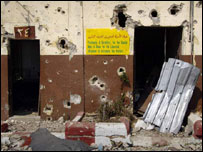
| Al-Khiyam prison - Israel's former detention centre in Lebanon
|
The jail was staffed by members of Israel's proxy militia, the South Lebanon Army, and operated outside the bounds of international safeguards, with many stories of torture and even prisoners dying from the abuse they received. After Israeli forces left Lebanon in 2000, and the SLA collapsed, the jail was taken over by Hezbollah, many of whose members had passed through its gates.
The site became a memorial to the liberation struggle and a symbol of the victory claimed by Hezbollah over Israel.
Thousands of people came from across the Arab and Muslim worlds and beyond to visit the jail, their way pointed out by brown "heritage site" road signs, and placards set up by Hezbollah's public relations department telling the story of the resistance.
However, hardly anything is left of the prison now. It was pulverised during the Israeli bombardment.
That does not mean al-Khiyam will stop being an integral part of the "Islamic resistance trail" when tourists finally do return to this unfortunate corner of south Lebanon.
Hezbollah can use rubble as well as - if not more effectively than - intact buildings in its publicity campaigns.


 One-Minute World News
  News services
 E-mail this to a friend
  Printable version
 In pictures