By Malcolm Brabant
BBC News, El Alamein, Egypt |

At the El Alamein war cemetery honouring nearly 20,000 allied dead, the silence of the desert is broken sound of a lawnmower cutting the grass in front of the graves.
 Locals believe thousands have been hurt by mines over the years |
It may exude the tranquillity of an English garden, but beyond the memorials, the western desert is as deadly as ever. Abdul Diyem Gatwa - a handsome bearded Bedouin in his mid-forties - jabs his deformed left hand as he talks about the perils of living near the battlefield.
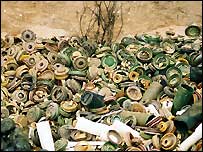
Three of his fingers are mere stumps, yet he is fortunate. Twelve members of his family have been killed by some of the 17 million mines still remaining in the western desert straddling Egypt and Libya.
Deadly playtime
Mr Gatwa says it is really quite dangerous around here.
"Children are maimed or killed. They lose their hands, feet, or legs, or become blind. They go out and play. They don't know what these things are. "Sometimes they are with their livestock and they step on mines. They go out to play or they don't come back," he says.
Victims of mines are easy to find. Another Bedouin, 60-year-old Mahmoud Bado, nearly died in the blast that rendered his right leg useless and blew away his left arm. His father was killed in a separate explosion.
"The Germans and British planted these mines," Mr Bado says.
 |  Their war and their mines have held back our development for more than 50 years Their war and their mines have held back our development for more than 50 years  |
"They have a responsibility to clear them up. De-mining would make this a safer place." Guide books advise visitors to the battlefield to stick to the paths because of the mines, especially around a squat sandstone mausoleum containing the remains of nearly 5,000 Germans.
They were caught by surprise when the allies punched a hole through minefields meant to protect them.
The British say they have offered technical assistance and training to the Egyptians. But diplomats in Cairo declined to talk on the record about the issue.
The projected bill for reclaiming the desert is put at $2bn.
Doud Mesari Hassan, a short wizened old Bedouin, occasionally guides tourists around the battlefield.
Find out more about the global landmine problem 
|
He has lived here since World War II and is in no doubt about what should be done: "This was a European war between the allies and the axis. They brought the war over here. It had nothing to do with North Africa.
"Their war and these mines have held back our development for more than 50 years."
If it could be reclaimed, this part of the desert close to the Mediterranean could accommodate millions of Egyptians currently living in overcrowded cities.
Egypt may complain about the desert's wartime legacy, but here's the ironic twist.
President Mubarak's government has yet to ratify international conventions banning landmines.
That gives Britain and Germany the perfect excuse to invoke European Union policy which bans mine clearing in non-compliant countries.


 One-Minute World News
  News services
 E-mail this to a friend
  Printable version
 At-a-glance

