By Martin Asser
BBC News Online |

The Green Zone - the administrative centre of Baghdad - is now officially called the International Zone, though it seems likely to keep its old name.
 Baath regime monuments dominate the whole area |
The "green" meant it was considered a safe area of operation - for the US civilian and military authorities in Baghdad, US contractors and the post-Saddam Iraqi government the Americans put into office.
However what was supposed to be the safest part of the Iraqi capital was the target of deadly attacks on Thursday.
The area is Green as distinct from the all-too-accurately named Red Zone that the rest of Iraq has become since the anti-US insurgency took hold a year ago.
The new name was meant to reflect the June 2004 refashioning of the Iraq occupation - with a handover of power to Iraqis, American diplomats helping guide them on their way and the US-led occupation army becoming the MNF (multi-national force).
However, as the insurgency has raged on, the Zone has remained what it always essentially was:
An American bubble squatting inconveniently in the middle of Baghdad, disrupting life for those on the outside and cushioning those inside from the everyday realities of the new Iraq.
Mendacious monuments
Inside, the centre of power has remained as in Saddam's day, the Republican Palace, a grandiose behemoth of a building set back from the riverbank on a wide bend on the Tigris.
The over-the-top architecture and interior design remain - complete with inscriptions of Saddam Hussein's sayings and murals of his megalomaniac fantasies - as a strange backdrop to the comings and goings of the US and other staff charged with rebuilding and reforming Iraq
Only the massive Saddam Hussein military busts have been removed from the corners of the building.
US officials are less than willing to identify it as the new embassy - for obvious reasons as the domed building is a very prominent Baghdad landmark. However it appears that the palace has taken on that role while a purpose-built building is prepared.
Other points of interest include a state-of-the-art convention centre said to now house the British mission and nearby the Iraqi interim government offices.
On the other side of the road - once a major Baghdad thoroughfare, now deserted - is the famous Rashid Hotel.
The hotel had been a Baath regime showpiece, complete with George Bush Snr floor mosaic for visitors to tread on as they entered and a nightclub where the rapacious Uday preyed on the womenfolk of Baghdad.
 Most Iraqi visitors only get to visit the interim government building |
Now - with the mosaic removed, but the disco still going strong - it houses Green Zone visitors and serves as a place for rest and recuperation breaks for US service people. Finally there are the monuments, such as the Tomb of the Unknown Soldier and the Victory Arch modelled on Saddam's hands brandishing swords, mendaciously marking the war of attrition against Iran in the 1980s.
Combat gear
It has to be said that, from its earliest days - when this part of Baghdad occupied by Saddam Hussein's most favoured minions was taken over by US forces - the Green Zone has struck a wrong note.
Iraq's American rulers - in the guise first of Jay Garner's ORHA, then Paul Bremer's CPA and now the US embassy - have operated behind tanks and barbed wire and, since the UN bombing last year, massive concrete blast walls.
The bureaucrats and the administrators seldom venture beyond the Green Zone's peaceful and spacious environment.
 The grand North Gate is the main entrance for visitors |
Inside they can hear the city's frequent gunfire and explosions - and come under attack themselves, by ill-directed mortars that usually graze the reinforced buildings or land in open ground. But it is by no means a front-line - though as one Green Zone observer, journalist William Langewieche, notes that does not prevent "romantic" military garb being warn by the residents.
"Many wear combat boots... and they go around in convertible cargo pants, safari vests, and no small number of bush hats," he writes in Atlantic Monthly.
"Many also carry guns (some in quick-draw holsters), though there is no obvious reason other than style, since the security is tight, and the Green Zone has proved to be safer than many American towns."
By contrast, ordinary Iraqis and non-resident foreigners summoned there by need or appointment are acutely aware of the dangers of bomb attack while waiting outside the North Gate (the Assassins' Gate, in Saddam's time) entrance to be checked before entering.
Under attack
For the first six months, hostility to the US only really manifested itself in noisy demonstrations outside the North Gate.
The first significant act of rebellion hit the Rashid hotel on 26 October 2003 - a dozen or so rockets fired as US deputy Defence Minister Paul Wolfowitz was shaving in his room on the 12th floor, killing one US soldier.
 Mortars frequently hit the Zone but not its buildings |
Since then most attacks have come frequently, but usually less effectively. Helicopter patrols overhead mean that attackers have no time to find the correct range for their mortars and most attacks fall on open ground.
Nearly a year later the first suicide bombing inside the Zone has brought an unpalatable truth - that not all the Iraqis who also work and live in there are to be trusted in American eyes.
There are an estimated 3,000 Iraqis inside the Zone. Some of them - squatters and street urchins who make a living selling knick-knacks to their co-residents - are opportunists who darted in as the regime was collapsing.
Then there are the legion of translators and other employees who keep the wheels of administration moving.
Whoever it was, the heavily-armoured, heavily-guarded fortress that is the core of US might in Iraq is going to need a security review.


 One-Minute World News
  News services
 E-mail this to a friend
  Printable version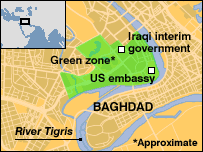

 Enlarge Image


