The International Institute for Strategic Studies (IISS) in London has delivered an in-depth report on the current weapons programme being undertaken by Iraq. Here are the key findings:Nuclear
Iraq does not possess facilities to produce fissile material (enriched uranium or plutonium) in sufficient amounts for nuclear weapons. 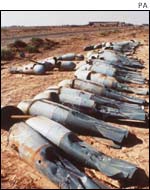 Iraq ''can deliver chemical or biological weapons in various tactical arms''
|
It would need at least several years and extensive foreign assistance to build such fissile material production facilities. It could probably assemble nuclear weapons within months if fissile material from foreign sources were obtained (and there is no evidence that this has happened). Biological
Iraq probably retained substantial growth media and biological weapons agents (perhaps thousands of litres of anthrax) from pre-1991 stocks. 
Iraq is capable of resuming chemical weapons production on short notice (months) 
|
IISS report |
It is capable of resuming production on short notice (weeks) and could have produced thousands of litres of anthrax, botulinium and other agents since 1998. (actual stocks unknown). Chemical
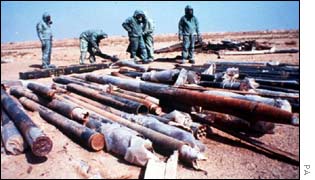
Iraq probably retained a few hundred tonnes of mustard agent and precursors for a few hundred tonnes of sarin/cyclosarin and perhaps similar amounts of VX from pre-1991 stocks. It is capable of resuming chemical weapons production on short notice (months) and could have produced hundreds of tonnes of agent (mustard and nerve agents) since 1998 (actual stocks unknown). Ballistic missiles
Iraq probably retained a small force of 650km (al-Hussein) missiles, perhaps around a dozen missiles. 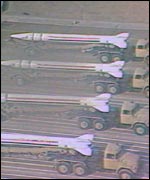 The Scud: Iraq's most effective weapon of the Gulf War
|
It does not possess facilities to produce long-range missiles, would require several years and extensive foreign assistance to construct such facilities. It may have produced some al-Samoud missiles with ranges up to 200km, and is capable of manufacturing rudimentary chemical/biological weapons warheads; development of more advanced designs unknown. Other delivery means
Iraq is capable of delivering chemical/biological weapons in various impact-fuse tactical munitions (artillery shells, rockets, aerial bombs). It could have a few thousand chemical weapons tactical munitions. It is capable of delivering biological weapons with simple airborne wet spray devices; a small inventory of modern strike aircraft with 750km combat radius; some ground attack aircraft, helicopters, possible unmanned aerial vehicles based on trainer aircraft. Note: These findings are in line with other reports, including a recently updated assessment by the Washington-based Centre for Strategic and International Studies.




 E-mail this story to a friend






