|
 |
 | | | | | | |||||||||||||||||||||||||||||||||||||||||||||||||||||||||||||||||||||||||||||||||||||||||||||||||||||||||||||||||||||||||||||||||||||||||||||||||||||||||||||||||||||||||||||||||||||||||||||||||||||||||||||||||||||||||||||
| | | You are in: Middle East | |||||||||||||||||||||||||||||||||||||||||||||||||||||||||||||||||||||||||||||||||||||||||||||||||||||||||||||||||||||||||||||||||||||||||||||||||||||||||||||||||||||||||||||||||||||||||||||||||||||||||||||||||||||||||||||||
|
| | Thursday, 8 August, 2002, 13:38 GMT 14:38 UK Analysis: Saddam's challenge 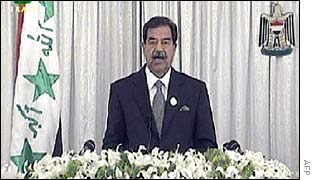 Saddam laid out conditions for arms teams to return
President Saddam Hussein's speech in Baghdad contained characteristic defiance of the threatened American military action to remove him from power. One rhetorical flourish - no doubt better in Arabic than English - warned the forces of evil that they would carry their coffins on their backs to die in failure and disgrace. There was also a vague threat of the scale of Iraqi retaliation: no greedy tyrant, Saddam Hussein said, should be misled into taking action that would have incalculable consequences. But what observers were looking for in the speech was some unambiguous statement on the possible return of United Nations weapons inspectors - excluded from Iraq since the large scale American and British air strikes at the end of 1998. On this point the Iraqi leader made it clear he was not prepared to re-admit the inspectors unconditionally, despite recent offers to discuss the issue. Iraqi overtures The Iraqi Government has made several moves suggesting that it might allow the UN to resume the search for chemical, biological and nuclear weapons.
It invited the chief arms inspector to talks in Baghdad; it proposed that members of the American Congress should look for weapons; or that British experts accompanied by the media should go and present their evidence to the Iraqis. These offers have been dismissed in Washington and London as not serious, and the UN has emphasised that the return of the inspectors has to follow the procedure laid down by the Security Council. In his speech, President Saddam Hussein did not refer to the offers or deal with the issue in any detail. But the message was clear enough when he said the Security Council should reply to the questions raised by Iraq in March and honour its obligations under its own resolutions. Those questions focused on UN sanctions and how long inspections would last. They were an attempt to bargain with the big powers. Weapons denial So the Iraqi leader is saying, in effect: if I let the arms inspectors back in, will UN sanctions be lifted? Iraq's argument is that it no longer has any weapons of mass destruction and so has fulfilled the requirements for that to happen. Saddam Hussein's words seem to rule out what the United States and Britain are demanding - the return of the inspectors on the terms laid down by the Security Council, with no conditions set by Iraq. British officials dismissed the speech as more rhetoric, in line with other Iraqi attempts at prevarication and obfuscation. They said it did nothing to address the real issue of the requirements of Security Council resolutions: Saddam Hussein knew what he had to do. Military option By rejecting the unconditional re-admission of the inspectors, the Iraqi leader is making it easier for US President George W Bush to argue that military action is the only option.
Full Iraqi co-operation, were it ever to happen, would create political difficulties for Washington. Even the British Government, its closest ally, has doubts about an attack on Iraq. On Wednesday, a Foreign Office Minister, Mike O'Brien, said that if the inspectors went back and international law were complied with, the position would be very different. In contrast, senior American officials have repeatedly suggested that UN inspectors on their own would not remove the threat of Iraqi weapons of mass destruction. Among these sceptics or hardliners are the Defence Secretary, Donald Rumsfeld, and most recently the Vice President, Dick Cheney. Such comments bolster Saddam Hussein's view that the Bush administration intends to attack him anyway, so what incentive does he have to comply? The deadlock remains intact. | |
See also:  08 Aug 02 | Middle East 08 Aug 02 | Media reports 07 Aug 02 | Middle East 07 Aug 02 | Middle East 07 Aug 02 | Middle East 02 Aug 02 | Middle East Internet links: The BBC is not responsible for the content of external internet sites Top Middle East stories now: Links to more Middle East stories are at the foot of the page. | |||||||||||||||||||||||||||||||||||||||||||||||||||||||||||||||||||||||||||||||||||||||||||||||||||||||||||||||||||||||||||||||||||||||||||||||||||||||||||||||||||||||||||||||||||||||||||||||||||||||||||||||||||||||||||||
| |
|  E-mail this story to a friend E-mail this story to a friend |
| |
| Links to more Middle East stories |
| | | ||
 | ||||
 | | Back to top
| ||
| ---------------------------------------------------------------------------------- To BBC Sport>> | To BBC Weather>> | To BBC World Service>> ---------------------------------------------------------------------------------- © MMIII | News Sources | Privacy |