
|
 |
 | | | | | |||||||||||||||||||||||||||||||
| | You are in: World: Middle East | |||||||||||||||||||||||||||||||||
 | | Sunday, 12 May, 2002, 15:28 GMT 16:28 UK Diary of Gaza City life 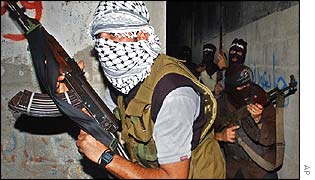 In Gaza the Palestinians are preparing to defend the city
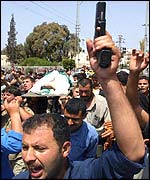
On the first day of his diary for BBC News Online, Paul Wood describes what life is like in Gaza City for the Palestinian people as they wait to see what military action Israel will take. In the streets below the BBC office, the raucous sound of a Hamas funeral demonstration - patriotic songs on the loudspeakers, green flags flying from the buses taking people to the meeting. This is a sign that things are relaxing here, everyone believing that the Israelis are not coming, at least not yet.
And journalists interviewing Hamas officials have been surprised by the moderate tone of the answers. "We don't want to take civilian life," one says when asked about suicide bombers. It is assumed the Palestinian Authority has told Hamas not to do anything to provoke the Israelis. Conflicting accounts Now it looks like back to business as usual. There is gunfire from the funeral. We go down to take a look. The body of a 13-year-old boy is being carried through the streets. His relatives, standing by the Hamas loudspeaker truck, say he was shot by the Israelis at the checkpoint up the road and left to bleed to death.
That is one version of what happened. The Israelis will, of course, deny it. An Israeli military build-up is continuing, although the defence minister, Binyamin Ben-Eliezer, says he is re-thinking what to do. I interviewed him just before coming to Gaza. He is of one the few Sephardic, or Oriental Jews, in a high position in an Israeli Government traditionally dominated by Ashkenazi, or European, Jews. He speaks and reads Arabic and tells me he made the journey to what is now Israel from Iraq in 1937, when he was just aged just 13. He has fought in many of Israel's wars. "I am sorry when I see any child die, Arab or Jew," he says. Civilians at risk But the expectation is that many civilians will be hurt if Israel does mount a major operation into Gaza. In Jabaliya, they have pushed mounds of earth into the wide central avenues to try to slow down the tanks. Some of these piles of earth are said to contain mines which can be detonated by remote control.
The fighters in Gaza are the most experienced the Palestinians have. They sent shock-waves through the Israeli general staff by managing to destroy two main battle tanks in early clashes. The wide avenues through Jabaliya's slums were created by army bulldozers during an earlier Israeli incursion, to make it easier for armoured vehicles to move around. That was 20 years ago - the defence minister then, one Ariel Sharon. | |
See also:  Internet links: The BBC is not responsible for the content of external internet sites Top Middle East stories now:  Links to more Middle East stories are at the foot of the page. | |||||||||||||||||||||||||||||||
|
Links to more Middle East stories |
 | | ^^ Back to top News Front Page | World | UK | UK Politics | Business | Sci/Tech | Health | Education | Entertainment | Talking Point | In Depth | AudioVideo ---------------------------------------------------------------------------------- To BBC Sport>> | To BBC Weather>> ---------------------------------------------------------------------------------- © MMIII|News Sources|Privacy  |




 E-mail this story to a friend