
|
 |
 | | | | | ||||||||||||||||||||||||||||||||||||||||
| | You are in: World: Middle East | ||||||||||||||||||||||||||||||||||||||||||
 | | Thursday, 28 March, 2002, 19:04 GMT Iraq pledges to respect Kuwait 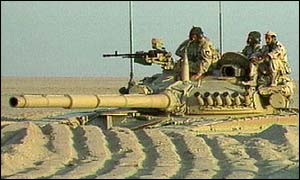 Kuwait has long been wary of its neighbour Iraq has received public backing from other Arab states after it promised to respect the independence and sovereignty of Kuwait, which it invaded in 1990. Iraq's pledge was contained in the final communique from the Arab League summit in Beirut, which also called for both sides to work to resolve disputes over prisoners of war.
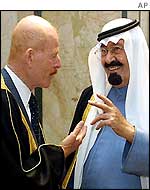
Arab leaders in response urged an end to UN sanctions against Baghdad and rejected any new military campaign against Saddam Hussein's regime - an indirect reference to recent US threats. In an immediate reaction, a State Department spokesman said Washington was "profoundly sceptical" of the agreement reached between Kuwait and Iraq. Embrace Live television pictures beamed back to Iraq from the Beirut summit showed a public display of harmony and reconciliation, with Crown Prince Abdullah of Saudi Arabia embracing and kissing Iraqi delegation head Ezzat Ibrahim.
Iraq has been engaged in a strenuous effort to try to improve ties with the rest of the Arab world, a diplomatic offensive given added urgency following President Bush's condemnation of Baghdad as part of the "axis of evil." US threat The BBC's Rageh Omaar in Baghdad, says Iraq's announcement shows just how seriously it is trying to build support among the Arab world to help prevent any American-led military action. Washington has accused Iraq of developing weapons of mass destruction and insists that Baghdad allow United Nations weapons inspectors back into the country. State Department spokesman Richard Boucher expressed pessimism over reports that Baghdad would respect Kuwaiti sovereignty. "If true, that would be good, but Iraq has never evidenced any real intent to respect Kuwaiti sovereignty. It has a deplorable record of flouting its international obligations and UN Security Council resolutions," he said. Significant The Beirut Declaration welcomes "Iraq's confirmation to respect the independence, sovereignty and security of the state of Kuwait and guarantee its safety and unity to avoid anything that might cause a repetition of what happened in 1990."
BBC diplomatic correspondent Barnaby Mason says the deal does not resolve all the disputes between Kuwait and Iraq, being more a starting point for doing so. But it is highly significant, he says, a solemn Iraqi undertaking endorsed by all the Arab states. Speaking on his return to Kuwait City, Kuwaiti Foreign Minister Sheikh Sabah al-Ahmed al-Sabah said he was completely satisfied with the agreement with Iraq, the French news agency AFP reported. Iraq invaded its neighbour in August 1990. Nine months later, it was ousted by a US-led multinational coalition. | |
See also:  Internet links: The BBC is not responsible for the content of external internet sites Top Middle East stories now:  Links to more Middle East stories are at the foot of the page. | ||||||||||||||||||||||||||||||||||||||||
|
Links to more Middle East stories |
 | | ^^ Back to top News Front Page | World | UK | UK Politics | Business | Sci/Tech | Health | Education | Entertainment | Talking Point | In Depth | AudioVideo ---------------------------------------------------------------------------------- To BBC Sport>> | To BBC Weather>> ---------------------------------------------------------------------------------- © MMIII|News Sources|Privacy  |







 E-mail this story to a friend