|
 |
 | | | | | | ||||||||||||||||||||||||||||||||||||||||||||||||||||||||||||||||||||||||||||||||||||||||||||||||||||||||||||||||||||||||||||||||||||||||||||||||||||||||||||||||||||||||||||||||||||||||||||||||||||||||||||
| | | You are in: In Depth: September 11 one year on | ||||||||||||||||||||||||||||||||||||||||||||||||||||||||||||||||||||||||||||||||||||||||||||||||||||||||||||||||||||||||||||||||||||||||||||||||||||||||||||||||||||||||||||||||||||||||||||||||||||||||||||||
|
| |  Tuesday, 13 August, 2002, 12:54 GMT 13:54 UK Tuesday, 13 August, 2002, 12:54 GMT 13:54 UK Aviation's continuing crisis 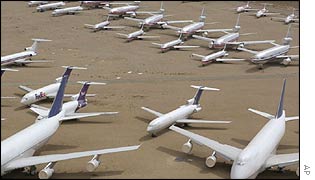 Airlines had to park up planes in California's desert
Even before the terrorist attacks on the US, many of the world's airlines were struggling. What 11 September did was to turn what would have been a bad year for the industry into a disastrous one.
"Some of them are on the verge of bankruptcy," said William Gaillard of the industry's international organisation, Iata. "The airlines lost last year as much as they had ever made since the Wright Brothers started flying in 1903," he added. 'An excuse' The airline industry suffered more than any other in the aftermath of the terrorist attacks. All flights to and from the US - as well as within the country - were grounded for the best part of a week.
And because the attacks were carried out using hijacked aircraft, when planes did get back in the air many people were too afraid to fly. Ticket sales dropped sharply. The price of shares in some of the US carriers fell by half. The airlines were in deep trouble and they were quick to respond by cutting tens of thousands of jobs and parking redundant aircraft in the US desert. The swift reaction caused many commentators to suggest that airlines were using 11 September as an excuse to push through cost-cutting measures that would have come in any event - although the scale was clearly greater than it would otherwise have been. Savings on fuel Earlier in 2001 passenger numbers had fallen for the first time in many years and, that summer, United Airlines, American Airlines and US Airways all reported heavy losses for the second quarter of the year. Those losses grew dramatically after the attacks. Figures from Iata show that scheduled international airlines turned a profit of $3.7bn (�2.4bn) in 2000 into a loss of $12bn in 2001. A loss of $8bn is predicted this year. As well as attracting fewer passengers, the airlines have had to pay for higher insurance and higher security - although, in most cases, higher insurance costs have been cancelled out by lower fuel prices, according to Rigas Doganis, former chief executive of Olympic Airways. No more day trips The continuing economic problems in much of the world - particularly the United States and Japan - have not helped a recovery in the airline industry.
A year after the terrorist attacks, passenger numbers in Europe have, by and large, recovered. In the United States it is a very different story. "It's the hassle factor," said William Gaillard, of Iata. "People are no longer worried about security, they're worried about the security checks. "Americans were used to going in 20 minutes before the flight took off, now it might be two hours. "They did New York to Chicago as a day trip - that's almost impossible these days," he said. More budget passengers International travel has also been affected with far fewer Americans flying to Europe. The weakening dollar has not helped. US airlines have suffered most, but carriers such as British Airways, which relies heavily on the North Atlantic routes, have also been badly hit.
One trend, which has been particularly noticeable in Europe, is that the low-cost airlines have been doing exceptionally well in the past year. Ryanair, Easyjet and Go responded to the crisis by cutting fares to encourage people to fly. They have been rewarded with more passengers and higher profits. But Mr Gaillard said this would have happened anyway because the airlines were already expanding and attracting new customers. In the US, JetBlue - a recently-launched budget airline - has done exceptionally well. Manufacturers still suffering None of that has been enough to help the manufacturers and their suppliers. With aircraft lying unused, demand for new planes has slumped. The UK's Farnborough air show is always a showcase for the industry and you can usually guarantee that the big companies will announce big deals. But this year Boeing had nothing to announce. It's rival, Airbus, gave details of a small order. But Professor Doganis says he thinks the problems facing the airline industry now have little to do with 11 September. "The continuing decline is due much more to the current economic crisis in the US and Japan and Germany," he said. Too many airlines The question the whole industry has been addressing is how can it recover? Mr Gaillard said that some airlines are making money this year, for example Air France, Iberia and Lufthansa. But the underlying problem is that the airline industry is still too big. "There are 75 airlines in Europe. It's far too many," said Mr Gaillard. But governments are reluctant to give up their flag carriers and that makes it difficult for the industry to slim down. The US is also reluctant to allow any mergers involving its airlines with overseas rivals. As for when the industry will become profitable again - Iata hopes that, as a whole, the world's airlines will break even in 2003. For US airlines alone it will take longer. They are talking about a recovery in 2004 - three years after the 11 September terrorist attacks propelled the industry from a crisis into a disaster. | |
See also:  02 Aug 02 | Business 30 Jul 02 | Politics 29 Jul 02 | Business 23 Jul 02 | Business 18 Jul 02 | Business 09 Jul 02 | Talking Point 02 Jul 02 | Business Top September 11 one year on stories now: Links to more September 11 one year on stories are at the foot of the page. | ||||||||||||||||||||||||||||||||||||||||||||||||||||||||||||||||||||||||||||||||||||||||||||||||||||||||||||||||||||||||||||||||||||||||||||||||||||||||||||||||||||||||||||||||||||||||||||||||||||||||||||
| |
|  E-mail this story to a friend E-mail this story to a friend |
| |
| Links to more September 11 one year on stories |
| | | ||
 | ||||
 | | Back to top
| ||
| ---------------------------------------------------------------------------------- To BBC Sport>> | To BBC Weather>> | To BBC World Service>> ---------------------------------------------------------------------------------- © MMIII | News Sources | Privacy |