
|
 |
 | | | | | | ||||||||||||||||||||||||||||||||||||||||||||||||||||||||||||||||||||||||||||||||||||||||||||||||||||||||||||||||||||||||||||||||||||||||
| | | You are in: Health | ||||||||||||||||||||||||||||||||||||||||||||||||||||||||||||||||||||||||||||||||||||||||||||||||||||||||||||||||||||||||||||||||||||||||||
|
| | Wednesday, 9 October, 2002, 18:01 GMT 19:01 UK Blood test may diagnose vCJD 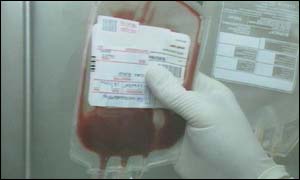 There is no test to screen blood for vCJD Scientists believe they are close to developing an effective test for vCJD - the human form of mad cow disease. Researchers in Germany say studies on animals have shown that it may be possible to identify the disease in humans using a simple blood test. They said the finding could help to ensure no one gets vCJD from donated blood. At present there is no accurate test for the disease.
Dr Dieter Naumann and colleagues at the Robert Koch Institute in Berlin tested hamsters for scrapie - a disease similar to BSE or mad cow disease and vCJD. Accurate diagnoses Their test picked up 97% of all infected samples, according to New Scientist magazine. Importantly, it had a 100% record in identifying healthy blood. The test, which can be completed in 15 minutes, works by comparing subtle chemical differences in healthy and infected blood. The German scientists are now extending their work to test for BSE in cows. If successful, the programme will then examine whether the test can pick up vCJD in humans. The UK's National Blood Service has filtered out white blood cells from donated blood since 1999 in an effort to reduce any risk. In a further precautionary step, the Department of Health announced in August that plasma for use in children born after 1995 would in future be imported from the United States where there have been no cases of BSE or vCJD. Professor Peter Smith, the government's leading adviser on the disease, said that "in an ideal world" all blood products would be imported from countries with no cases of BSE. A study to be published next week - details of which were leaked in August - suggests that the human form of the disease may be transmitted in plasma or red blood cells. The study, carried out by the Institute of Animal Health, concluded that further research is needed to identify which components of blood may carry the disease. Blood imports At the moment, plasma and red blood cells are not filtered out of blood donated in Britain. Professor Smith said: "We do not have a screening test for vCJD so in an ideal world we might consider obtaining blood from other sources outside the UK. "However, my understanding is that this is not feasible because of the amount of blood we use." Speaking to BBC News Online, he added: "There hasn't been any case of vCJD being transmitted through donor blood and that provides us with some reassurance." A spokesman for the National Blood Service said that it was taking all practical steps to reduce the risk of vCJD in donated blood. "There is an unknown risk and vCJD may be transmissible through blood products," he told BBC News Online. "Scientific evidence suggests that if it was transmissible it would be most likely to be transmitted through white blood cells." | | See also:  16 Aug 02 | Health 16 Aug 02 | Health 29 Jan 02 | Health 15 Nov 01 | Health 03 Aug 02 | Health Internet links: The BBC is not responsible for the content of external internet sites Top Health stories now: Links to more Health stories are at the foot of the page. | ||||||||||||||||||||||||||||||||||||||||||||||||||||||||||||||||||||||||||||||||||||||||||||||||||||||||||||||||||||||||||||||||||||||||
| |
|  E-mail this story to a friend E-mail this story to a friend |
| |
| Links to more Health stories |
| | | ||
 | ||||
 | | Back to top
| ||
| ---------------------------------------------------------------------------------- To BBC Sport>> | To BBC Weather>> | To BBC World Service>> ---------------------------------------------------------------------------------- © MMIII | News Sources | Privacy |





