
|
 |
 | | | | | | ||||||||||||||||||||||||||||||||||||||||||||||||||||||||||||||||||||||||||||||||||||||||||||||||||||||||||||||||||||||||||||||||||||||||
| | | You are in: Health | ||||||||||||||||||||||||||||||||||||||||||||||||||||||||||||||||||||||||||||||||||||||||||||||||||||||||||||||||||||||||||||||||||||||||||
|
| | Monday, 7 October, 2002, 01:23 GMT 02:23 UK Sound waves to cut op risk 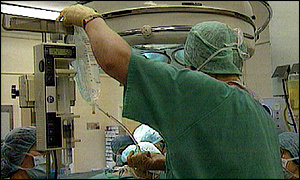 Fluid levels need to be topped up during surgery Hospital stays could be cut by a new technique that uses reflected sound waves to administer fluids and plasma more effectively to a patient during major surgery. Tests revealed that patients on whom the technique was used experienced less nausea and vomiting following surgery, and were able to eat solid foods much earlier and recovered more quickly. Fluids such as blood, plasma or synthetic agents are given to patients undergoing major surgery to compensate for blood loss and to maintain blood pressure. The fluids are added in response to changes in blood pressure, urine output or heart rate. But even so it can be difficult to prevent the patient's fluid levels from dropping too low. This can affect the proper functioning of the intestines as blood is diverted away to vital organs, and result in a slowing of the recovery process. Faster response The new technique works by using sound waves to measure the heart's pumping action. This enables doctors to top up fluids more quickly, before danger signs become apparent. The technology, known as an oesophageal Doppler monitor (EDM), works by placing a small ultrasound probe down the food pipe to a location next to the aorta - the main artery out of the heart. By measuring the reflection of sound waves directed into the aorta, the EDM is able to measure and calculate the volumes of blood being pumped out of the heart and to the body. Researcher Dr Tong Joo Gan, an anaesthesiologist at Duke University Medical Center in North Carolina, said the technique could have a significant impact. He said: "The traditional reactive indicators do not always accurately reflect the status of fluids, since the changes we see tend to occur later than the actual fluid loss. "With the Doppler technology, we get continuous, real-time measurements, which allows us to maintain a patient's fluid levels at a more constant and natural state. "This study shows that by keeping the fluid levels from dropping, patients will recover faster and leave the hospital sooner." Positive effects The study focussed on 100 patients who required major surgery on the prostate, colon, bladder, pancreas, liver or major gynaecological procedures.
The EDM group began tolerating solid foods three days after surgery, compared to five days for the control group. More than twice the number of patients in the control group experienced severe postoperative nausea and vomiting. Professor Peter Hutton, president of the UK Royal College of Anaesthetists, said the device was potentially another useful tool for help patients. He told BBC News Online: "The estimation of fluid levels during prolonged and major surgery is always difficult. "Anything which helps to improve fluid levels must be in the patients' best interest." Professor Hutton said similar devices were already used in cardiac operations to assess the functioning of heart valves. But he warned that the equipment was extremely expensive. The research is published in the journal Anesthesiology. | | See also:  04 Oct 01 | Health 10 Nov 01 | Health 11 Jan 02 | Health Internet links: The BBC is not responsible for the content of external internet sites Top Health stories now: Links to more Health stories are at the foot of the page. | ||||||||||||||||||||||||||||||||||||||||||||||||||||||||||||||||||||||||||||||||||||||||||||||||||||||||||||||||||||||||||||||||||||||||
| |
|  E-mail this story to a friend E-mail this story to a friend |
| |
| Links to more Health stories |
| | | ||
 | ||||
 | | Back to top
| ||
| ---------------------------------------------------------------------------------- To BBC Sport>> | To BBC Weather>> | To BBC World Service>> ---------------------------------------------------------------------------------- © MMIII | News Sources | Privacy |





