
|
 |
 | | | | | | ||||||||||||||||||||||||||||||||||||||||||||||||||||||||||||||||||||||||||||||||||||||||||||||||||||||||||||||||||||||||||||||||||||||||||
| | | You are in: Health | ||||||||||||||||||||||||||||||||||||||||||||||||||||||||||||||||||||||||||||||||||||||||||||||||||||||||||||||||||||||||||||||||||||||||||||
|
| | Tuesday, 13 August, 2002, 00:29 GMT 01:29 UK Police improve heart attack survival rates 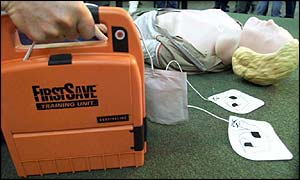 Defibrillators are now kept in public places Giving police defibrillators improves people's chance of surviving a heart attack, US researchers have found. The findings follow controversy in the UK last month over fire crews attending cardiac arrest victims after a man died. In the US trial in Miami-Dade County, Florida, police as well as fire services, were given defibrillators. The scheme led to response times to sudden cardiac arrest victims being cut by almost three minutes.
Training fire services in cardiac resuscitation skills has been tried before, but data from both large urban areas with heavy traffic congestion and from rural areas showed survival rates as low as 1% to 2%. But Dr Robert Myerburg, American Heart Association chair of cardiovascular research at the University of Miami School of Medicine and his team decided to extend the scheme to the police. He said: "The theory is that police are already on the road when a call comes in, so there is a potential for faster response." Faster responses The 911 emergency dispatch system in the area was changed so that both police and fire/rescue services were dispatched to certain medical emergency calls. Each of the area's 1,900 police officers were given defibrillators.
Between 1 February, 1999 to 30 April, 2001, 56,000 medical emergency calls that triggered the dual deployment system. In 420 cases, patients had suffered cardiac arrests. Police arrived first 56% of the time. For cardiac arrests, help arrived in under five minutes in 41% of calls, compared to 14% for the standard fire/rescue calls. The survival rate for types of cardiac arrest which could benefit from defibrillation - ventricular fibrillation or pulseless ventricular tachycardia - was 17%, compared to 9% in the year-and-a-half before the scheme was introduced. However, almost two-thirds of the cardiac arrest victims attended had non-shockable rhythms, which cannot be helped with a defibrillator. This reduced the overall improvement in survival rates to 1.6%. Important step Dr Myerburg said it was likely that the high rate of non-shockable rhythms represented time lost from onset of symptoms to making the 911 call. "With longer time from onset of cardiac arrest to treatment, the likelihood of survival declines." Since the trial ended, another 400 defibrillators have been given to police in the area. The research was published in Circulation, the journal of the American Heart Association. Writing in an editorial in the journal, Dr Jose Joglar and Dr Richard Page of the University of Texas Southwestern Medical School in Dallas, said: "The Miami-Dade experience represents one important step in a long journey toward optimising care for the victim of sudden cardiac arrest." Colin Elding, UK Manager of Heartstart at the British Heart Foundation, said: "The BHF considers it a priority to equip first responders such as the police service with defibrillators. "Every year around 270,000 people have heart attacks in the UK and around half die before they reach hospital. "Waiting for professional help to arrive could be too late and early action from a first responder or a bystander trained in emergency life support can mean the difference between life and death." | | See also:  31 Jul 02 | Health 08 Jun 01 | Health 07 Jun 01 | Health 13 Jul 00 | Health 16 Apr 00 | Health Internet links: The BBC is not responsible for the content of external internet sites Top Health stories now: Links to more Health stories are at the foot of the page. | ||||||||||||||||||||||||||||||||||||||||||||||||||||||||||||||||||||||||||||||||||||||||||||||||||||||||||||||||||||||||||||||||||||||||||
| |
|  E-mail this story to a friend E-mail this story to a friend |
| |
| Links to more Health stories |
| | | ||
 | ||||
 | | Back to top
| ||
| ---------------------------------------------------------------------------------- To BBC Sport>> | To BBC Weather>> | To BBC World Service>> ---------------------------------------------------------------------------------- © MMIII | News Sources | Privacy |





