
|
 |
 | | | | | ||||||||||||||||
| | You are in: Health | ||||||||||||||||||
 | | Thursday, 23 May, 2002, 15:55 GMT 16:55 UK New weapon in superbug war 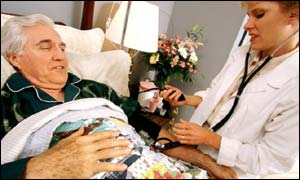 Hospital patients are vulnerable to superbug infections Scientists believe they have found a new way of tackling antibiotic-resistant bacteria - helped by people who have survived an infection. The threat from so-called "superbugs" appears to be on the rise. This week, the Public Health Laboratory Service confirmed the first English strain resistant to the antibiotic vancomycin, one of the few drugs which still has some potency. However, while most effort is being directed at producing new types of conventional antibiotics, a team of scientists based at Manchester University is taking a different tack. They are drawing on the power of people who have survived infection with drug-resistant bacteria to help others fight it. Antibody attack The Manchester team has managed to identify antibodies in the blood of MRSA survivors. These were developed by the patient in response to the infection, and appear able to destroy the bacteria. Researchers say that if similar antibodies are injected into another stricken patient, it will bolster their defences. Even more encouragingly, the antibodies appear to be even more effective when used in concert with an existing antibiotic. Double approach Dr James Burnie, who is leading the team, says that it may prove tougher for the superbug to develop resistance to this two pronged approach. He told BBC News Online: "It is always harder for resistance to develop to a combination therapy. "In TB for example, it is when drugs are given on their own that there is a risk of resistance." One technological breakthrough is finding the ability to copy these antibodies in large numbers. This means they can then be given to another patient - whose immune system then benefits. Human trials Dr Burnie has raised millions via a share flotation to pursue the project. He told a conference of the American Society of Microbiology in Salt Lake City this week that in experiments in mice infected with MRSA, the antibody treatment inhibited the growth of bacteria. Giving their drug to the mice produced a 10-fold decrease in the number of "viable bacteria" in the liver and spleen, they said. Antimicrobial experts from the UK say that it is too early to say whether the technique will work in humans as well as it does in animals. However, trials of the antibody drug are about to start in humans, meaning, if it works, it could become available in just a few years. Overuse of antibiotics is blamed for much of the rise of resistance to the drugs among bacteria. However, after a campaign by health authorities in the UK, encouraging data from the Office of National Statistics, released on Thursday, suggests that use is decreasing, particularly among children. The research was reported in New Scientist magazine. | | See also:  Internet links: The BBC is not responsible for the content of external internet sites Top Health stories now:  Links to more Health stories are at the foot of the page. | ||||||||||||||||
|
Links to more Health stories |
 | | ^^ Back to top News Front Page | World | UK | UK Politics | Business | Sci/Tech | Health | Education | Entertainment | Talking Point | In Depth | AudioVideo ---------------------------------------------------------------------------------- To BBC Sport>> | To BBC Weather>> ---------------------------------------------------------------------------------- © MMIII|News Sources|Privacy  |


 E-mail this story to a friend