By Steven Eke
Russia analyst, BBC World Service |
  Moscow's leaders saw the proposed defence system as aimed at Russia |
The US decision to back away from a proposed missile defence system for Central Europe will be portrayed as a victory for Russian diplomacy by most Russian commentators and the hardline security and defence establishment. Alexander Konovalov, the head of the Institute for Strategic Assessments in Moscow, said the proposed system's effectiveness was low, the cost would be enormous and the attitude of the Czech authorities, in particular, was not favourable. However, Mr Konovalov urged caution, warning that the victory was one "for common sense", rather than Moscow. It would be irrational, he said, to spend billions of dollars "developing an unproven system against a non-existent threat in conditions of economic crisis". Other commentators in Moscow have welcomed the step as a sign of the end of what they call the "messianic world vision" of the previous US administration of George W Bush. Officially, Russia never accepted the pretext that the missile defence system would protect Central Europe against a potential missile threat from Iran or North Korea. Instead, Russia always insisted that the system was aimed at Russia, designed specifically to undermine Russia's own nuclear deterrent by removing the existing strategic parity. Powerful argument The issue emerged into one of the most divisive issues, and seemingly unbridgeable difficulties, between Moscow and Washington.  | Ranges of Russian Intercontinental Ballistic Missiles 
|
The willingness of the Polish government to host part of the system also contributed to the serious tensions to have plagued Polish-Russian links in recent years. This came to the fore in August 2008, during the Russo-Georgian war, when Polish President Lech Kaczynski said Russia's actions were a powerful argument for the missile defence system. While there has been a thaw in Russo-Polish relations over the past year, renewed sensitivities have emerged in connection with the 70th anniversary of the start of World War II. Russian approaches to much of the former Soviet Union and the former Eastern European empire are based on the projection of hard power. There are many people in Poland, the Czech Republic and the other former vassal states who fear Russia's intentions and renewed assertiveness. Reset button Earlier this year, leading political and cultural figures from the region wrote an open letter to US President Barack Obama, asking him not to be influenced by Russian objections to the missile defence shield. Reading like a plea not to be abandoned, it served as a pertinent reminder that there are deep concerns about the possible impact of Mr Obama's pledge to "press the reset button" with Moscow. The restarting has so far produced very little for the US in terms of concessions from Russia. Indeed, a number of hardline Russian publications today write that abandoning the missile defence shield means an end to the notion of "strategic partnership" between Washington and the "small nations" of Central Europe. Moscow has sought to play on divided public opinion in Central Europe, and has repeatedly suggested that Europe should build a common security and defence policy without American participation. Nonetheless, Dmitry Rogozin, Russia's Ambassador to Nato, and a hard-line negotiator, told the BBC's Russian Service on Thursday that the "breakthrough" decision removed a "major irritant" in US-Russian relations. Cold War legacy Intriguingly, the US decision comes at a time of intense, new speculation over apparent differences of political vision and future direction in the Russian leadership. Vladimir Putin led Russia during a time of chronic tensions with the US, and oversaw the drive to restore Russian global military influence.  Putin oversaw the drive to restore Russian global military influence |
It was perhaps not entirely coincidental that this went hand-in-hand with the cementing of anti-Americanism as an apparently key element in Russian thinking. Russia's foreign minister denies the existence of "institutionalised" anti-Americanism in Russia, but it is rarely concealed. Mr Putin's successor, Dmitry Medvedev, has recently expanded on his view of Russia's future. His focal point has been the country's economic and technological backwardness. The future vision is one of a democratic society driven by and for scientific modernisation and the rule of law - not by "great power" status or a global role. So a number of Russian analysts have cautiously suggested the US decision might bolster the democratic instincts apparently personified by Mr Medvedev. The liberal-leaning gazeta.ru website, respected for its commentaries, called on the Kremlin to respond to the US decision with "mutuality". After "years of brainwashing" with anti-Americanism, it wrote, Moscow should now demonstrate a more pragmatic outlook when it comes to joint Russian-European-US approaches to Iran and its possible nuclear ambitions. President Medvedev is in the US next week for the G20 summit and the United Nations General Assembly. His every word will be scrutinised to determine whether Russia feels it has scored an important diplomatic and strategic victory over the US; or whether the US decision on missile defence opens the way to a genuinely new phase in Russia's thinking about the West.
|  One-Minute World News


 E-mail this to a friend
  Printable version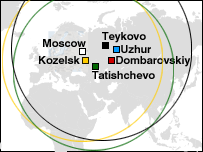
 Enlarge Image


 BBC News


Bookmark with:
What are these?