By Kerry Skyring
BBC News, Vienna |

His reputation as a peacemaker and statesman suffered following allegations that the Germany army unit he served in committed atrocities during World War II.
 | The emergence of this picture proved explosive 
|
The allegations arose in 1986, shortly after he had been nominated for the Austrian presidency.
Current Austrian President, Heinz Fischer, offered "deepest condolences" to the Waldheim family and the flag on the presidential palace is flying at half-mast.
Foreign Minister Ursula Plassnik said Mr Waldheim had combined "a deep love of his homeland with untiring engagement for European and world politics".
The Social Democrat Chancellor, Alfred Gusenbauer, said Kurt Waldheim had served Austria in many ways, "as diplomat, as politician, as president and as United Nations secretary general".
He added that the election of Mr Waldheim as president had led to Austrians discussing and "coming to terms with their past".
He meant the wartime past and the involvement of many Austrians in Nazi war crimes. It was this past that overshadowed the last two decades of Mr Waldheim's life.
In 1986, it was alleged that Mr Waldheim's army unit had committed war crimes in the Balkans.
|  My enemies kept bringing up new charges against me and promising new evidence. But this evidence never appeared My enemies kept bringing up new charges against me and promising new evidence. But this evidence never appeared |
Mr Waldheim strenuously denied all the allegations and an investigation by an international commission found no proof that he had committed war crimes.
However, it became clear that the former UN chief had either lied about important details of his wartime service or deliberately concealed them.
Despite the controversy, he was elected Austrian president with more than 53.6% of the vote.
Senior political commentator Anneliese Rohrer told the Austrian radio station FM4 that "his campaign and his presidency really forced Austria, for the first time, to look at herself, and some things we saw were not a pretty sight".
"Willingly or unwillingly, we had to confront some facts of the past," Ms Rohrer said.
The "Waldheim affair" - as it became known - would haunt the former statesman for the rest of his life.
He was never again allowed to travel to the United States, but he continued to defend himself to the end, saying that he had just been a soldier "doing his duty" during the war, like "thousands of other Austrians".


 One-Minute World News
  News services


 E-mail this to a friend
  Printable version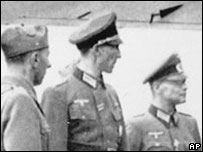
 Enlarge Image


