 The pro-Putin United Russia party is likely to be a clear winner |
Campaigning has ended for Russia's parliamentary election on Sunday. There are 23 parties running for 450 places in the State Duma, or lower house, but analysts say only about seven have a real chance of seats.
A party backed by President Vladimir Putin, United Russia, is tipped to dominate along with the Communists and the far-right Liberal Democrats.
Mr Putin has said the bombing of a train on Friday which killed 42 people was an attempt to disrupt the polls.
 |  It's all been decided and nothing changes anyway It's all been decided and nothing changes anyway  |
The President of the European Commission, Romano Prodi, sent his condolences and condemned the attack but said it must not affect the turnout on Sunday. "No terrorist act should deter the Russian electorate from exercising their democratic rights," he said.
The chairman of the Russian Central Electoral Commission, Alexander Veshnyakov, said all polling stations would open on 7 December despite attempts to thwart the ballot and destabilise the situation, and he promised a free and fair vote.
Any attempt at falsification would, he said, be punished by "tough measures".
He also promised to publish results from across the country's 11 time zones on the internet within 24 hours of polling stations closing.
Apathy
The election will decide the make-up of the Duma for the next four years.
Any party gaining 5% of the vote will be represented in parliament.
Reports from BBC correspondents around the country suggest there is a sense of apathy among voters who believe the outcome is largely a foregone conclusion - United Russia first, followed by the Communist Party second.
"Why should I bother?" one Russian, 40-year-old Alexander Likhachov, told Reuters news agency in St Petersburg.
"It's all been decided and nothing changes anyway."
Popular policies
A number of parties have expressed their anger at the public backing the president has given United Russia.
Russian election factfile 
|
BBC Russian affairs analyst Stephen Dalziel says that if Mr Putin has a Duma which largely supports him, it will be more difficult for any challenger in the presidential elections next March.
After nearly four years in the Kremlin, Mr Putin, the former head of the secret police, still appears to be riding a wave of genuine support.
The hard line his administration has taken against corruption and wealthy oligarchs - namely the arrest of oil billionaire Mikhail Khodorkovsky for tax evasion - has gone down well with voters.
With the support of a victorious United Russia and some liberal parties, some analysts say Mr Putin's second term might not be his last as the two-term limit specified in the Russian Constitution could be changed by a two-thirds vote in the Duma.
More than 1,100 international observers from 48 states have been accredited for the election, but their numbers may increase to 2,000.
Because Russia is so vast, with 11 different time zones, the first polling stations open in the Far East at the equivalent of 2000 GMT on Saturday and the last ones close in the enclave of Kaliningrad at 1800 GMT on Sunday.


 One-Minute World News
  News services
 E-mail this to a friend
  Printable version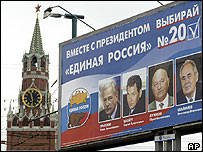
 At-a-glance


