 Election posters will remain in evidence for some time |
Elections to replace ousted Georgian President Eduard Shevardnadze will be held on 4 January, parliament has decided. The veteran leader stood down on Sunday after weeks of protests against failed parliamentary elections, ending in the storming of parliament.
Those election results were annulled by the Supreme Court earlier on Tuesday.
Opposition leader Mikhail Saakashvili is widely tipped as the most likely successor to Mr Shevardnadze.
Acting President Nino Burjanadze told parliament: "Today we are starting a new era. We should stand side by side independent of nationality, independent of political interests."
Justice has won in Georgia
Shalva Tsiklauri, artist 
|
Judges who annulled the parliamentary election said the decision by the court in the former Soviet republic was final "and cannot be contested". International observers said the elections were marred by "spectacular" irregularities.
The election result, giving victory to supporters of Mr Shevardnadze, was at odds with opinion polls suggesting they would lose their majority in parliament.
On Tuesday, Georgian State Minister Avtandil Jorbenadze announced his resignation, following the departure of Interior Minister Koba Narchemashvili on Monday.
Both men were key ministers in Mr Shevardnadze's administration.
"I am a person who does not change his principles and because of this I have made my decision to resign," Mr Jorbenadze told a news conference in Tbilisi.
Mr Shevardnadze resigned after opposition leader Mikhail Saakashvili gave him an ultimatum to quit at talks mediated by Russian Foreign Minister Igor Ivanov. Mr Shevardnadze has said he has no intention of leaving Georgia.
There was speculation that the former leader would leave Georgia following an invitation from the German Government to move there.
But on Monday he said: "Although I love Germany very much, my homeland is Georgia and I owe it to her to stay here."
Ms Burjanadze has promised to protect the former president if he stays.
International reaction
The US has developed strong interests in Georgia since its independence and is the main backer of a pipeline designed to bring oil from the Caspian Sea to the West via Georgia.
But the European Union struck a note of caution, saying democratic elections must be held to "restore a climate of trust and confidence".
Russian President Vladimir Putin expressed reservations about the way in which Mr Shevardnadze was forced from power.
Russia and Georgia have had tense relations since Georgia became independent with the break-up of the Soviet Union.
Russia accuses Georgia of harbouring Chechen militants, while Georgia accuses Moscow of backing separatist movements in the country.


 One-Minute World News
  News services
 E-mail this to a friend
  Printable version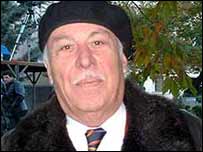
 In pictures


