 Mayor Hamdija Jahic placed the keystone in position |
An historic bridge which was destroyed during the Bosnian war has reached the final stage of its reconstruction. The 16th Century bridge in Mostar, part of a Unesco world heritage site, had its keystone laid into place in a special ceremony attended by local politicians and community leaders.
Hundreds of people watched and cheered as a crane slowly lowered the final stone slab into place, bringing together the two halves of the 30-metre-long arch.
"The Old Bridge will once again be the symbol of coexistence and a united Mostar," said the city's mayor, Hamdija Jahic.
Mostar's Old Bridge before, during and after the war 
|
The bridge was built by the Ottomans and survived relatively intact through Bosnia's turbulent history. Its destruction by Croat forces in November 1993 was seen as a sign of the complete disintegration of Bosnia's Muslims, Croats and Serbs.
"The bridge was a symbol of Bosnia's multi-ethnic, multi-cultural way of life," said BBC South-East Europe analyst, Gabriel Partos.
"Its destruction was seen by many as an act of cultural vandalism against the country's Ottoman Turkish and Muslim heritage - a heritage that people across all of Mostar's communities had taken pride in before the war."
Mostar's Croat and Muslim communities fought each other for 11 months during Bosnia's 1992-95 war, and the city remains divided today.
Croats live mainly on the west bank of the river, and Muslims on the east bank. Most of the city's Serbs fled, and only a few have returned.
The rebuilding of the old bridge - though it is not the only one across the river - is seen by many as an important step towards re-uniting the Croat and Muslim communities.
Croatia and Turkey are among the contributors to the $20m (18-million-euro) project, which is being carried out under Unesco's supervision.
Some of the stone from the destroyed bridge, which fell into the Neretva River, is being used in the new bridge.
The rest has come from the same quarry which supplied the original stone for the bridge 500 years ago.
Each stone has been carved by hand using traditional tools.
The bridge will be opened to the public in spring 2004.


 One-Minute World News
  News services
 E-mail this to a friend
  Printable version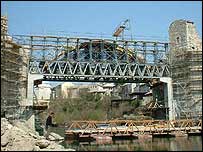
 In pictures


