 Some of the fires crossed the border from Spain |
The Portuguese Government has declared the forest fires raging across the country a public calamity, paving the way for compensation for victims.
More than 3,000 firefighters, backed by 400 soldiers, were battling around 70 fires which were burning across Portugal on Monday.
The Portuguese fires have claimed nine lives, thousands of hectares of forest and an unknown number of homes.
"We are facing an exceptional situation," Prime Minister Jose Durao Barroso told reporters after an emergency Cabinet meeting. "It's been brought about by absolutely exceptional weather conditions, so we have to respond with exceptional measures."
The government has pledged more than 110m euros ($124m) in aid for people who have lost their jobs and homes, for farmers who have lost crops and livestock and for local councils to rebuild infrastructure.
Across the border in Spain, the death toll in the extreme heat rose to seven over the weekend. The victims are thought to have died from the effects of the heat.
Temperatures in the southern region of Andalucia have risen above 40C (104F), with some towns recording their highest-ever temperatures. Forest fires have continued to burn in Extremadura, a remote region to the north which borders Portugal.
As the heat wave continued to grip much of Western Europe:
- Technicians doused the Fessenheim nuclear power station near Strasbourg, France, with cold water to prevent it overheating
- Police in the Ile de France region around Paris lowered speed limits from 50 km/h (30 mph) to 30 km/h because of ozone levels in the capital 65% above levels considered safe for humans
- Rail speed restrictions were imposed in the UK amid fears that tracks might buckle in the heat, as weather officials said midweek temperatures could surpass the country's record of 37.1C (98.8F).
- This year's wheat harvest in the Czech Republic, already hit by poor winter weather, was predicted to plummet to 2.7m tonnes - down from nearly 4m tonnes last year.
Despite the severity of the fires, the Portuguese prime minister rejected calls for the government to declare a national emergency, noting that emergency plans were in place in the three districts where the worst of the fires were concentrated.
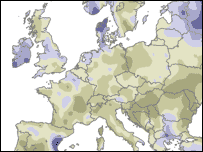
Click below to see rainfall levels in Europe, April-June 2003 
|
Fires are still burning in 15 of the country's 18 districts and some are still out of control.
About one-third of the country is covered by forest, and each year thousands of trees burn down in summer fires.
Officials say 26,00 hectares (64,000 acres) had already been destroyed before the latest wave of fires.
One fire alone last week destroyed 11,000 hectares, making it the largest individual fire for 15 years.
Outside help
Officials say it is impossible to estimate how many homes have burned down.
With local fire brigades struggling to cope, Portugal has requested help from outside. Two firefighting planes from Italy and five from Morocco came into action on Sunday.
Spanish firefighters are also helping their Portuguese colleagues.
Portugal has also activated a European Union civil defence mechanism aimed at prompting rapid action by member states to supply manpower and equipment.


 One-Minute World News
  News services
 E-mail this to a friend
  Printable version
  We are standing before a tragedy which is unprecedented in Portugal in terms of fires

 Enlarge Map


