By Inigo Gurruchaga
Basque journalist |

 One of the goals of hotel bombs is to damage Spain's economy |
The bombing attacks perpetrated by Basque terrorist group ETA in Alicante and Benidorm this week did not require great skills or logistics. According to Spanish police, a young man in his twenties booked a room in one hotel and left a bag with a bomb inside.
Shortly afterwards he did the same thing in a second hotel less than an hour's car drive from the first.
ETA does not measure the impact of those two bombs in human costs.
In its 30 years of existence, Basque terrorism has maimed and killed people of different nationalities and creeds, including children and housewifes, so called "legitimate targets" and passers-by.
Deadly missions
With those two bombs, ETA has achieved two goals.
 |  Gone are the days, in the late 1970s, when ETA was able to kill 100 people per year on average Gone are the days, in the late 1970s, when ETA was able to kill 100 people per year on average  |
First, it reminded the world of its existence. Second, it damaged the Spanish economy, which relies so heavily on its reputation as a tourist destination.
But the Spanish Government is telling the truth when it says that ETA has never been so weak.
Gone are the days, in the late 1970s, when the group was able to kill 100 people per year on average - just as Spain was awakening from a long dictatorship and moving towards democracy.
The ETA of today has some logistical networks in France and a pool of a few hundred youths scattered across the borders of the Basque Country, in France and Spain, willing to engage in deadly missions. French and Spanish police have successfully reduced ETA's capability and the Spanish Government and judiciary have banned the political wing of the movement, which seeks an independent state for the Basques.
The logic for banning the political wing, which has operated for the last decade under different names - Herri Batasuna, Euskal Herritarrok, Batasuna - is that both wings are inextricably linked.
Banning the political branch will therefore reduce the flow of funds and support to ETA units.
Political gamble
In 1998, ETA began an 18-month truce, which brought the political wing its highest local election result, around 15%.
But since the return to war, the political wing has suffered badly, plunging below 10% of the vote.
Mainstream Basque nationalists are trying to lead ETA towards peace by making themselves more radical.
They are offering Basque radicals a stark choice: either unite with peaceful nationalists around a programme for Basque self-determination or get squeezed out of politics.
This intricate political gamble is being played in an atmosphere of harsh confrontation with the Spanish Government.
Prime Minister Jose Maria Aznar has steadfastly refused to contemplate political dialogue as a way to achieve peace in the Spanish Basque region.
ETA is sending Mr Aznar a message with the two latest bombs: "We are still here, you have not defeated us."
And Mr Aznar's message to ETA is equally clear: "We have not defeated you yet but that is our highest goal."
Inigo Gurruchaga is London correspondent for El Correo


 One-Minute World News
  News services
 E-mail this to a friend
  Printable version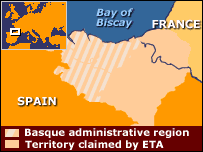

 Enlarge Map

