|
 |
 | | | | | | |||||||||||||||||||||||||||||||||||||||||||||||||||||||||||||||||||||||||||||||||||||||||||||||||||||||||||||||||||||||||||||||||||||||||||||||||||||||||||||||||||||||||||
| | | You are in: Europe | |||||||||||||||||||||||||||||||||||||||||||||||||||||||||||||||||||||||||||||||||||||||||||||||||||||||||||||||||||||||||||||||||||||||||||||||||||||||||||||||||||||||||||||
|
| | Wednesday, 4 September, 2002, 18:00 GMT 19:00 UK Industrial heartland's change of heart 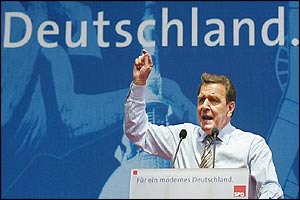 Schroeder needs to win disillusioned voters back (AP)
When Germany's Chancellor Gerhard Schroeder addressed a key election rally in Duesseldorf on Wednesday, he should have been preaching to the converted. The city is the capital of Germany's largest state and it has been a strong Social Democratic heartland for 30 years. But times are changing - unemployment in some areas is as high as in Eastern Germany and traditional voters are disappointed and restless.
It is a former mining area in transition. It is not pretty, but there are few indications that unemployment here is a staggering 18%. That is higher than in many parts of the former Communist Eastern Germany. One in five of all German voters live in North Rhine Westphalia, a traditional Social Democratic heartland - which leaves everything to play for the key parties. Disillusion One would expect the workers at the American-owned TRW car component company to be die-hard SPD voters and supporters of Chancellor Gerhard Schroeder, but many are disillusioned.
"I'm not happy about what the last years has done. The CDU must have a chance. It must be better," says one. "Normally I do vote SPD - it's the lesser evil," says another, "it's in the family. "But no party has the concept to end our misery, though on balance I'd still vote for them." That is hardly a ringing endorsement. The company is facing another wave of job cuts. Labour costs are high, not least because of generous social provisions. The plant manager, Heinz Stuck, says a radical shake-up of labour laws is needed to create more flexibility. "It might be we are missing a market sector - looking at what Stoiber has achieved in Bavaria. This is the kind of competence I think we are looking for," he says. Germany must change, he says. "We can't live in splendid isolation." Apathy Gerhard Schroeder promised to get unemployment below three-and-a-half million and he failed. For traditional SPD supporters in the unions, the key battle now is with voter apathy.
Jorn Meiner of the IG Metall union knows what is at stake. "If they can't win in North Rhine Westphalia, I think they will never win," he says. "We are I think a little bit disappointed. I can say 'Go vote, whatever you vote, but vote'. Because if you do not, you get the one you don't want." Opposition Christian Democrats' leader Edmund Stoiber's strongest card is his economic record as prime minister of Bavaria. But his CDU-CSU Party know a demand for no-holds-barred labour market reform will be political suicide in the state. "I do not want to have a policy of hire and fire. We have regulations but we have too many regulations and some of them must be taken away," says CDU MP Wolfgang Meckelburg. "Mr Stoiber is someone who really knows how to work. He has good results and that's what we need really." Sleaze A string of sleaze scandals have also added to the SPD's troubles in the state. But despite unemployment, the region continues to attract high levels of foreign investment and the transition from old industry to creative service economy has had some success. At meetings across the region, it is a record the State Prime Minister, Wolfgang Clement, is happy to defend. "The people here recognise structural change quickly," he says. "We're better than Bavaria in this respect, but there are no political heartlands now - the voters have changed. This region is not a typical industrial area." There are more voters in this state than in all of Eastern Germany and as the flood waters there recede, attention will switch back to the red-green government's economic record. And it is voters here who will decide the key question for Chancellor Gerhard Schroeder - does he stay or does he go? | | See also:  04 Sep 02 | Europe 02 Sep 02 | Europe 26 Aug 02 | Media reports 23 Aug 02 | Europe 22 Aug 02 | Business 17 Jun 02 | Europe Internet links: The BBC is not responsible for the content of external internet sites Top Europe stories now: Links to more Europe stories are at the foot of the page. | |||||||||||||||||||||||||||||||||||||||||||||||||||||||||||||||||||||||||||||||||||||||||||||||||||||||||||||||||||||||||||||||||||||||||||||||||||||||||||||||||||||||||||
| |
|  E-mail this story to a friend E-mail this story to a friend |
| |
| Links to more Europe stories |
| | | ||
 | ||||
 | | Back to top
| ||
| ---------------------------------------------------------------------------------- To BBC Sport>> | To BBC Weather>> | To BBC World Service>> ---------------------------------------------------------------------------------- © MMIII | News Sources | Privacy |