|
 |
 | | | | | | |||||||||||||||||||||||||||||||||||||||||||||||||||||||||||||||||||||||||||||||||||||||||||||||||||||||||||||||||||||||||||||||||||||||||||||||||||||||||||||||||||||||||||||||||||||||||||||||||||||||||||||||||||||||||||||||||||||||||||||||
| | | You are in: Europe | |||||||||||||||||||||||||||||||||||||||||||||||||||||||||||||||||||||||||||||||||||||||||||||||||||||||||||||||||||||||||||||||||||||||||||||||||||||||||||||||||||||||||||||||||||||||||||||||||||||||||||||||||||||||||||||||||||||||||||||||||
|
| | Sunday, 18 August, 2002, 15:43 GMT 16:43 UK The art of the political cartoonist 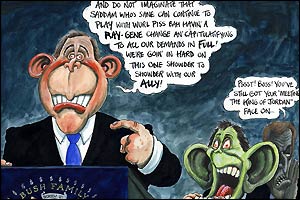 Martin Rowson satirises the Bush-Blair relationship The cartoon has been a feature of political life in many countries for centuries - satire and lampoon often used to deflate the pompous and self-important and make a point with the use of sometimes savage humour. The World Today, on the BBC's World Service, is running a series of features looking at the art of the political cartoonist. Arts correspondent Lawrence Pollard spoke to one of Britain's foremost political cartoonists about his work. Martin Rowson's attic studio is full of sharp objects, pens, quills, and nibs as well as the inkpots and jam jars which he uses to produce his fierce political cartoons. Lying on his desk are his latest targets, Bush and Blair. His editors have mixed views about what he's actually trying to do.
"Many editors think you're either a joker or an artist - I'm neither - I'm a visual journalist, I use humour to make a journalistic point." He also uses savage caricature and distortion to make his point, something that a photograph or article is unable to do. "In a cartoon, the visual experience has been synthesised through the cartoonist's eye and mind - it's very primitive. You've stolen their soul, and it's quite apparent that its my view.
"I've made people into toilets, pools of sick, pigs. What's interesting is the way politicians react - they will quite often buy the cartoons as a way of defusing the magic, defusing the voodoo, taking back possession of themselves. "I think they pretend they don't mind, while cartoonists pretend they matter." 'Jesters in court' And as he painted in a bilious green Tony Blair and a dumb President Bush, Rowson mused on whether or not his cartoons actually do matter. "I think we matter, but don't make much difference.
"We are court jesters, we can say the unsayable, but the problem is that if you're a jester you say what you want to say but at the end of the day, the King remains the King. "If you live in a liberal democracy, he won't chop your head off, or throw you into prison, or ban you from publishing, which is what is happening to cartoonists around the world." Behind the theoretical freedom of the press in Britain, there is of course the self-censorship of taste, of what is 'sayable' and what is not. That issue was paramount in the minds of satirists and cartoonists in the aftermath of the terror attacks of 11 September. One cartoonist described it as waiting for when to tell a joke at a funeral. 'Aflicting the comfortable' Rowson took his time before responding to the attacks: "Satire is about afflicting the comfortable and comforting the afflicted. I thought the cartoon was an inappropriate medium to express what I felt.
"The political ramifications are fair game however, so I didn't do Bush in the week after the attack because he was the symbol of the American people and they were the afflicted. "But once he started reacting to that atrocity with an equal and opposite atrocity, he became somebody afflicting other people and it became my job to afflict him." Martin Rowson tells a sad little story about the one time he really really thought he'd "got the buggers". During the Scott Inquiry into the allegations that the UK Government had exported weapons to Iraq, he did a cartoon on Saturday night for the Monday paper. "I sat there looking at it for 20 minutes thinking "Yes, this is IT, this will really hurt them. "And then a few days later one of my 'victims' bought it for �400. Oh well, I thought, half a million people will have seen it in the paper and �400 is always nice." Tables turned However try to return the compliment - and cartoon Rowson himself - and he's not amused: "I've been done a few times at cartoon conventions and I dislike it intensely. I don't think it looks like me, the very fact they've done it is a gross intrusion on my personal liberty. "I think it's disgusting and disgraceful and should probably be made illegal." And taking his tongue out of his cheek, he turns back to making his subjects as disgusting and disgraceful as his pen will let him. The BBC World Service's 'The World Today ' programme is broadcasting a week of items about political cartoonists around the world, from Monday 19 August. As well as Lawrence Pollard's full interview with Martin Rowson, there are features on censorship, taste, caricature and the future of political cartoons. | |
See also:  08 May 02 | Politics 05 Nov 01 | Politics 29 Nov 00 | UK Internet links: The BBC is not responsible for the content of external internet sites Top Europe stories now: Links to more Europe stories are at the foot of the page. | |||||||||||||||||||||||||||||||||||||||||||||||||||||||||||||||||||||||||||||||||||||||||||||||||||||||||||||||||||||||||||||||||||||||||||||||||||||||||||||||||||||||||||||||||||||||||||||||||||||||||||||||||||||||||||||||||||||||||||||||
| |
|  E-mail this story to a friend E-mail this story to a friend |
| |
| Links to more Europe stories |
| | | ||
 | ||||
 | | Back to top
| ||
| ---------------------------------------------------------------------------------- To BBC Sport>> | To BBC Weather>> | To BBC World Service>> ---------------------------------------------------------------------------------- © MMIII | News Sources | Privacy |