|
 |
 | | | | | | ||||||||||||||||||||||||||||||||||||||||||||||||||||||||||||||||||||||||||||||||||||||||||||||||||||||||||||||||||||||||||||||||||||||||||||||||||||||
| | | You are in: Business | ||||||||||||||||||||||||||||||||||||||||||||||||||||||||||||||||||||||||||||||||||||||||||||||||||||||||||||||||||||||||||||||||||||||||||||||||||||||||
|
| | Monday, 12 August, 2002, 13:19 GMT 14:19 UK Profile: Kemal Dervis 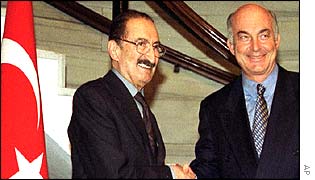 Bulent Ecevit (left) wanted Dervis to define his position Kemal Dervis shot to international attention last year when he was drafted in to help the Turkish government fix the worst economic crisis in Turkey's modern history. He was a senior official at the World Bank, where he had worked since 1978, and he had no political base in Turkey.
At the time Ragip Gultekin, chairman of an association of provincial businessmen, complained: "People are behaving as if a saviour, a messiah is coming." Painful reforms For many Turks, disillusioned with traditional politicians, Mr Dervis' frank manner came as a breath of fresh air. And his relations with international lenders proved invaluable. He secured a vital $16bn (�10.5bn) package of IMF loans and embarked on an ambitious, and often painful, economic recovery programme. He worked tirelessly to bring down interest and inflation rates, and to stabilise the Turkish lira. He also helped to introduce reforms designed to tackle corruption. A former colleague at the World Bank described Mr Dervis as "a fairly forceful man who knows his own mind". 'Extremely astute' "He's a very impressive guy," said David Lubin, emerging markets economist at HSBC. "He's certainly one of the most credible economic policymakers in emerging markets. "He's also played an extremely astute political game." Mr Dervis has had to work closely with the Prime Minister, Bulent Ecevit - but it was not the first time they had worked together. Before his move to the World Bank Mr Dervis was an economist and an adviser to Mr Ecevit, who served several stints as Prime Minister in the 1970s. In recent months the relationship between the two men has soured. 'Too American' In July, when the ailing prime minister's party began to fall apart, Mr Dervis followed a string of other ministers by resigning. He was persuaded to stay on, but then resigned a second time and announced he would be working to unite Turkey's centre-left politicians before elections due in November. In spite of his achievements, critics say that he is "too American" and does not understand Turkey. "It could work against him and certainly that's why his popularity is 60% not 80%," said Mr Lubin. No mandate But he said that while, on the one hand there was a strong willingness to preserve the Turkish identity, on the other hand there was a strong desire to modernise and move westwards. Mr Dervis might represent the best chance of combining those two desires. But his former World Bank colleague said: "The issue is who he joins forces with domestically and politically. "It might be that he will not have a mandate come November." | |
See also:  10 Aug 02 | Europe 05 Aug 02 | Europe 04 Aug 02 | Europe 01 Aug 02 | Business 02 Aug 02 | Europe 27 Jul 02 | From Our Own Correspondent Internet links: The BBC is not responsible for the content of external internet sites Top Business stories now: Links to more Business stories are at the foot of the page. | ||||||||||||||||||||||||||||||||||||||||||||||||||||||||||||||||||||||||||||||||||||||||||||||||||||||||||||||||||||||||||||||||||||||||||||||||||||||
| |
|  E-mail this story to a friend E-mail this story to a friend |
| |
| Links to more Business stories |
| | | ||
 | ||||
 | | Back to top
| ||
| ---------------------------------------------------------------------------------- To BBC Sport>> | To BBC Weather>> | To BBC World Service>> ---------------------------------------------------------------------------------- © MMIII | News Sources | Privacy |