
|
 |
 | | | | | ||
| | You are in: World: Europe | ||||
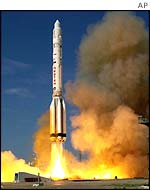
 | | Sunday, 12 May, 2002, 13:41 GMT 14:41 UK World's largest launch facility 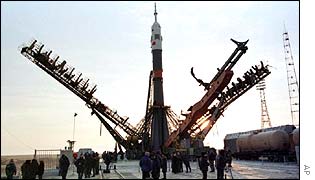 The precise location of the facility was kept secret for decades The Baikonur cosmodrome, also known as Tyuratam, is the world's oldest and largest working space launch facility. The first man�made satellite to orbit the Earth was launched from here. More recently, it has been used to launch rockets bound for the International Space Station.
They opted for a barren location on the steppes of Kazakhstan at Tyuratam railway junction on the banks of the Syr Darya River. The remote location was perfect for testing missiles that were capable of flying thousands of kilometres but needed to land within Soviet territory. Secret location The surrounding steppes are littered with spent boosters, many with toxic propellants still on board - although clean-up plans are underway. Construction on the facility began in 1955 with the Soviets also building the city of Leninsk nearby to provide apartments, schools and support for workers.
After two years, the complex at Tyuratam was fully functioning, with thousands of workers in place. But for decades, the facility was shrouded in secrecy with the Soviet authorities refusing to confirm its precise location. In 1961, to register Yuri Gagarin's flight as a world record, the Soviet authorities named Baikonur, a mining town 350km (220 miles) away from Tyuratam, as the launch site for the mission - and the name stuck. In the mid-1990s, former president Boris Yeltsin renamed the city of Leninsk, Baikonur Gagarin's legacy The first launch complex built in 1955 included a single launch pad and the assembly and processing buildings. The R-7 missile blasted off from there in May 1957 and the world's first artificial satellite took off from the same pad on 4 October 1957. Following the launch of Vostok-1 in 1961, the pad was nicknamed Gagarin's pad. The launch pad has remained operational since, having hosted more than 400 launches. The facility has been the site of all manned Soviet and CIS launches and of most lunar, planetary, and geostationary orbit launches. Since 1993 the facility has been rented from Kazakhstan. Most of the people working at the site and the military forces protecting it are Russian. There has been a long-running dispute between Russia and Kazakhstan on the level of payments for the lease of the cosmodrome, and recently Moscow started developing its own site at Plesetsk in the Archangel region of Northern Russia. | | See also:  Internet links: The BBC is not responsible for the content of external internet sites Top Europe stories now:  Links to more Europe stories are at the foot of the page. | ||
|
Links to more Europe stories |
 | | ^^ Back to top News Front Page | World | UK | UK Politics | Business | Sci/Tech | Health | Education | Entertainment | Talking Point | In Depth | AudioVideo ---------------------------------------------------------------------------------- To BBC Sport>> | To BBC Weather>> ---------------------------------------------------------------------------------- © MMIII|News Sources|Privacy  |


 E-mail this story to a friend