
|
 |
 | | | | | |||||||||||||||||||||||||||
| | You are in: World: Europe | |||||||||||||||||||||||||||||
 | | Wednesday, 10 April, 2002, 14:50 GMT 15:50 UK Yugoslavia paves way for extraditions 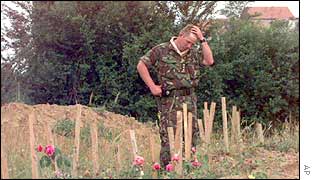 The suspects are wanted for atrocities in the Balkans The upper house of the Yugoslav parliament has passed a draft law which will allow the extradition of war crimes suspects to the international tribunal in The Hague.
It is still being debated by the lower house of parliament. At stake is $40m of aid which the US has frozen until further extraditions take place.
Socialists and radical nationalists oppose the law, but President Vojislav Kostunica has predicted that it will be passed within days. "This parliament has never before discussed an act of treason," raged Zivorad Igic, a senior member of the Socialist Party of former president Slobodan Milosevic. "Not only does it violate the constitution, but it also punishes the people who defended the constitution by defending their country." The upper house approved the law by 25 votes to seven. Serbian Prime Minister Zoran Djindjic has said that once the law has come into effect, the first suspects could be extradited within three weeks. Limitations Three of four men indicted with Mr Milosevic for war crimes in Kosovo are thought to be most at risk - a former deputy prime minister, a former interior minister, and a former army chief of staff.
However, the tribunal and the US have said that only unconditional co-operation will satisfy them. The draft law says that any future indictments would be dealt with by the Yugoslav courts. If it is passed, up to 15 men could be arrested and handed over to the war crimes tribunal. The fourth man indicted along with Mr Milosevic is Serbian President Milan Milutinovic but Serbian ministers have said they do not want him extradited while in office. One of the most wanted Bosnian Serbs, the former military leader, Ratko Mladic, is also believed to be living in Yugoslavia. Montenegro resignations In a separate development on Wednesday, four pro-independence ministers resigned from the Montenegrin Government in protest at parliamentary approval for a new union with Serbia. The resignations, by Social Democrat ministers, leaves the government without a parliamentary majority and could lead to early elections. The union replaces the Yugoslav federation with a loose union between Serbia and Montenegro, in which both partners would enjoy considerable autonomy. They would also have the option of going their separate ways in three years. The plan requires Montenegro to abandon plans for a referendum on independence, which the West fears could spark regional violence. It was approved by parliament in both Serbia and Montenegro on Tuesday, but has yet to be passed by the federal parliament. | |
See also:  Internet links: The BBC is not responsible for the content of external internet sites Top Europe stories now:  Links to more Europe stories are at the foot of the page. | |||||||||||||||||||||||||||
|
Links to more Europe stories |
 | | ^^ Back to top News Front Page | World | UK | UK Politics | Business | Sci/Tech | Health | Education | Entertainment | Talking Point | In Depth | AudioVideo ---------------------------------------------------------------------------------- To BBC Sport>> | To BBC Weather>> ---------------------------------------------------------------------------------- © MMIII|News Sources|Privacy  |


 E-mail this story to a friend