
|
 |
 | | | | | |||||||||||
| | You are in: World: Europe | |||||||||||||
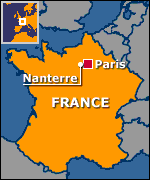
 | | Wednesday, 27 March, 2002, 11:23 GMT Nanterre murders test election candidates  A grim-faced Chirac was at the scene by 0700
Even before the gun massacre in Nanterre, crime had already emerged as arguably the biggest single issue in the presidential election. Crime figures released in January showed a leap in crime statistics of nearly 8%, and "l'insecurite" has been among the key concerns expressed by voters in a campaign which has otherwise failed to come to life. Election front-runners Lionel Jospin and Jacques Chirac have both made the fight against crime a top campaigning issue. Both rushed to Nanterre within hours of the attack - Mr Jospin arriving first, at four in the morning, followed by Mr Chirac at seven.
Both had already been trying to look tougher than the other on the issue. Mr Jospin has vowed to be tough on crime and on its causes, echoing the UK's Tony Blair. Mr Chirac has also borrowed a slogan, pledging "zero tolerance". But both men are struggling to win on an issue which could equally easily prove their undoing. Sticky wicket The problem for Mr Jospin is that his government stands accused of five years of being rather too soft on crime and criminals. Police discontent has also bubbled to the surface in recent months, fuelled by anger at a series of murdered officers and at poor pay and conditions. But Mr Chirac too has a major problem. Having refused to answer questions in a top-level corruption inquiry, he has been accused of believing in zero tolerance for everyone except himself. The attack in Nanterre, an apparently random act by a disturbed individual, may not sit easily in France's overall debate on how to cut crime.
It is the epicentre of some of the most serious sleaze claims facing Mr Chirac, following the return from exile of a former local councillor, Didier Schuller, who has implicated the president in a corruption scandal. Only the day before the shootings, another Hauts-de-Seine mayor had announced a breakthrough in combating crime. Manuel Aeschlimann, of Mr Chirac's right-wing RPR party, revealed that in his town, Asnieres, a curfew on young people had yielded dramatic results. General delinquency had fallen 23%, and juvenile delinquency 77%, since the curfew was introduced last November, he revealed on Tuesday. | | See also:  Top Europe stories now:  Links to more Europe stories are at the foot of the page. | |||||||||||
|
Links to more Europe stories |
 | | ^^ Back to top News Front Page | World | UK | UK Politics | Business | Sci/Tech | Health | Education | Entertainment | Talking Point | In Depth | AudioVideo ---------------------------------------------------------------------------------- To BBC Sport>> | To BBC Weather>> ---------------------------------------------------------------------------------- © MMIII|News Sources|Privacy  |


 E-mail this story to a friend