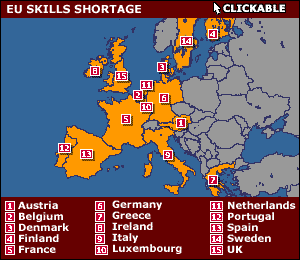
Western Europe, with its increasingly elderly population and declining birth rate, needs migrants to offset labour shortages. In particular demand are IT personnel, but other professionals, as well as agriculture, construction and catering workers, are also needed.
Click on the map above or scroll down to find out more.
Austria
Over 65s (as % of population): 15.5%
Births per woman: 1.4
Unemployed: 3.6%
Foreigners: 9.3%
IT skills shortage is particularly acute in the capital, Vienna, where most high-tech jobs are concentrated. The right-wing government has plans for a compulsory cultural programme for immigrants.
Back to map
Belgium
Over 65s: 16.7%
Births per woman: 1.6
Unemployed: 6.6%
Foreigners: 8.3%
IT skills shortage has more than doubled in recent years. Authorities are considering immigration quotas to counter people-smuggling.
Back to map
Denmark
Over 65s: 14.8%
Births per woman: 1.7
Unemployed: 4.3%
Foreigners: 4.8%
As in other high-tech Nordic countries, the IT skills shortage is pronounced, but government has begun taking steps.
Back to map
Finland
Over 65s: 14.83%
Births per woman: 1.7
Unemployed: 9.1%
Foreigners: 1.7%
Finland is one of the world's most technologically advanced countries. Surveys show its skills shortage in the IT sector beginning to ease.
Back to map
France
Over 65s: 16.02%
Births per woman: 1.7
Unemployed: 8.6%
Foreigners: 5.5%
Skills shortage is below the European average because of a rise in the number of IT professionals. France has spearheaded a European push for "controlled" immigration.
Back to map
Germany
Over 65s: 16.24%
Births per woman: 1.4
Unemployed: 10%
Foreigners: 9%
Has largest IT skills gap in Europe. New bill allows limited immigration by foreign workers. Employers' organisations say 1.5 million highly-skilled posts need to be filled.
Back to map
Greece
Over 65s: 17.29%
Births per woman: 1.3
Unemployed: 10.2%
Foreigners: no data
Relatively low skills gap, but expected to become more of a problem as late adoption of new technologies gathers pace.
Back to map
Ireland
Over 65s: 11.21%
Births per woman: 1.9
Unemployed: 3.8%
Foreigners: 3.3%
Total IT skills shortfall has almost doubled in three years. Recent boom has attracted many from UK and beyond.
Back to map
Italy
Over 65s: 17.97%
Births per woman: 1.2
Unemployed: 9.5%
Foreigners: 2.2%
Italy has become the biggest magnet in Europe for new migrants from Africa and Asia. About 100,000 newcomers arrive annually - the vast majority legally. Most are drawn by demand in labour-starved factories of the north. Government plans are to get tougher with asylum seekers.
Back to map
Luxembourg
Over 65s: 14.27%
Births per woman: 1.7
Unemployed: 2.4%
Foreigners: 33%
Skills gap comparatively low and immigration less of an issue in a country with so many foreign citizens.
Back to map
Netherlands
Over 65s: 13.56%
Births per woman: 1.6
Unemployed: 2.4%
Foreigners: 4.1%
Takes in foreigners every year, especially to pick tulips and asparagus. Facing particularly acute skills shortages, but is expected to be in vanguard of EU countries to address the issue.
Back to map
Portugal
Over 65s: 15.37%
Births per woman: 1.5
Unemployed: 4.1%
Foreigners: 1.8%
As in other southern European countries the skills gap is expected to widen as new technologies take hold. New centre-right government has pledged to introduce tight limits on immigration, but a study in August 2001 said 22,000 foreign workers were needed.
Back to map
Spain
Over 65s: 16.78%
Births per woman: 1.1
Unemployed: 13%
Foreigners: 2%
Skills gap has widened considerably in last couple of years. Poses questions for the government, which wants to tighten controls on illegal immigrants but recognises the country needs foreign workers.
Back to map
Sweden
Over 65s: 17.29%
Births per woman: 1.5
Unemployed: 5.1%
Foreigners: 5.4%
Sweden's progress into a high-tech future has shown signs of faltering, but a wide skills gap, as in other Scandinavian countries, is expected to narrow. The country has a record of taking in refugees and asylum seekers - about 10% of its population are immigrants.
Back to map
United Kingdom
Over 65s: 15.6%
Births per woman: 1.7
Unemployed: 5.1%
Foreigners: 3.8%
Has Europe's second biggest skills gap, after Germany, and there are calls for immigration controls to be relaxed to help plug it. The government's education policy is aimed at delivering highly skilled workers of the future, but plans for citizenship tests for immigrants were unveiled earlier this year.
Back to map




 E-mail this story to a friend