
|
 |
 | | | | | ||||||||||||||||
| | You are in: World: Europe | ||||||||||||||||||
 | | Thursday, 28 February, 2002, 09:57 GMT Turkey plays Europe's waiting game 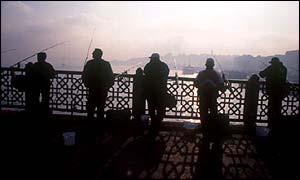
It first made a bid to be an associate of what was then the European Community in 1959. Since then Turkey has seen other countries jump ahead in the queue while its own relationship with Brussels has faltered. The country's ongoing financial crisis appeared to some to put the brakes on Turkey's progress towards Europe. Relations with the United States and the IMF suddenly seemed much more important.
"We desperately need to attract foreign investment," said one bank worker, Funda Hanoglu. "Because of the crisis industrialists have stopped investing. By joining Europe we can create a climate where foreign businessmen feel it is safe to bring their money into Turkey." Uncertainty Not everybody shares her level of enthusiasm. There is considerable uncertainty across all levels of society as to whether the country's future lies in Europe or whether, as a secular Islamic nation, Turkey should seek to develop alliances elsewhere. Islamists, nationalists and those on the left all share a degree of scepticism about what membership of the EU would mean for Turkish identity and about Brussels' true intentions towards their country.
"Turkey should try and multiply its relationships with other countries," he says, "particularly the Balkans, Russia, the Islamic world and North Africa. "These are all places which it has neglected at the expense of its attempts to be a full member of the European Union." Human rights One obstacle in the way of Turkey joining the EU is its poor human rights record. Political Islamists in Turkey see Brussels' emphasis on human rights as nothing more than a delaying tactic, concealing a deep-seated anti-Islamic bias at the heart of Christian Europe. Many Turks can still quote comments made by Jaques Delors when he was EC president in 1989, that Europe was "a product of Christianity, of Roman law and of Greek humanism". These words, they believe, closed the door firmly on their country's European aspirations.
As a result, they say, Turkish citizens are unclear about what it means to fully participate in the democratic process and ill-prepared to deal with the complexities of European politics. "Hundreds of thousands of people have been tortured physically in Turkey," says Feray Salman of Turkey's Human Rights Foundation. "The effect of this goes beyond the individual themselves to the families and the society in general. It creates a kind of broken society that can never come together." Similar fractures at government level between members of the fragile three-way coalition have slowed down the pace of legislative reform - a prerequisite of EU membership. Death penalty The far-right Nationalist Action Party (MHP) is deeply sceptical about Europe and bitterly opposed to the introduction of any legislation which it thinks will undermine Turkish sovereignty. It is staunchly opposed to European demands for the abolition of the death penalty - seeking the execution of PKK leader Abdullah Ocalan for his role in the conflict in the south-east of the country, which cost an estimated 30,000 lives. The EU's latest annual progress report on Turkey praised the government for its work during a marathon legislative session last September, when the authorities finally succeeded in amending the country's constitution in line with EU norms. But little has subsequently been done to bring the country's legislation into line with the constitutional reforms.
Without any clear definition of what constitutes a crime, judges are left to interpret the law as they see fit - reflecting the prevailing political mood. According to author and political analyst Dr Cengiz Aktar, Turkey is now at a crossroads. "It could follow the route of Spain, a former military state that has now become a model of democracy," he says, "or it can become like Iraq, another secular Islamic country, but totally authoritarian, where democracy doesn't really exist." But the most likely option is that Turkey will continue the internal debate about its identity and continue to keep its place on Europe's waiting list. | | See also:  Internet links: The BBC is not responsible for the content of external internet sites Top Europe stories now:  Links to more Europe stories are at the foot of the page. | ||||||||||||||||
|
Links to more Europe stories |
 | | ^^ Back to top News Front Page | World | UK | UK Politics | Business | Sci/Tech | Health | Education | Entertainment | Talking Point | In Depth | AudioVideo ---------------------------------------------------------------------------------- To BBC Sport>> | To BBC Weather>> ---------------------------------------------------------------------------------- © MMIII|News Sources|Privacy  |


 E-mail this story to a friend