 Peck was one of the Hollywood greats |
Hollywood stars and leading figures have lined up to pay their respects to actor Gregory Peck, who died on Thursday aged 87. Peck, the Oscar-winning leading man seen in films such as To Kill A Mockingbird and Cape Fear, died peacefully in his bed at his Los Angeles home with his wife Veronique at his side.
The actor and his French-born wife had been the guests of French President Jacques Chirac at the opening of the 1998 World Cup in Paris.
 Gregory Peck was one of those few great actors of generosity, humour, toughness and spirit Gregory Peck was one of those few great actors of generosity, humour, toughness and spirit  |
Mr Chirac said on Thursday: "Gregory Peck was not only an American film giant whom we admired, he was a man of exceptional culture, a man with a heart who was attentive to others and deeply concerned about world events." And Frank Pierson, president of the Academy of Motion Picture Arts and Sciences, said the movie industry has "lost one of its most honoured actors and finest citizens".
HAVE YOUR SAY Gregory Peck - one of a kind |
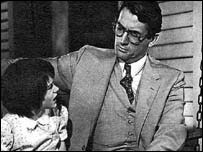
He said the actor's Oscar for playing liberal lawyer Atticus Finch in 1962's To Kill a Mockingbird was "slightly ironic", adding: "It was a part in which he only had to play himself, not someone else." Peck started his film career in the 1940s and was regarded as one of the last great Hollywood leading men.
Actor Charlton Heston, who co-starred with him in 1958's Big Country, also paid tribute.
 French leader Jacque Chirac paid tribute to Peck's "exceptional culture" |
"Gregory Peck was one of those few great actors of generosity, humour, toughness and spirit," he said, adding the actor "faced life's challenges with great vigour and courage".
And actress Anjelica Huston said Peck was "a complete gentleman, kind, dignified, proper, without ever being stiff, fun, a great conversationalist, someone who I respected ever so much",
As well as his Hollywood career, the actor was well-known for his liberal causes, and was an outspoken civil rights activist in the 1960s.
The life and career of Gregory Peck 
|
"Gregory Peck was a tower of integrity," said California governor Gray Davis. "He was the quintessential good guy both on screen and off," he said.
French actor Louis Jourdan, who had been Peck's friend for more than 50 years, described the actor as "an exceptional man, an implacable man", and said he "more than loved him. I admired him immensely".
Peck made his film debut in 1944 in Days of Glory, winning an Academy Award nomination for his second big screen role, playing a priest, in Keys of the Kingdom.
Glamour 'over'
Audiences preferred him as a leading man and attempts at unsympathetic roles were usually less-well received.
He played the renegade son in the Western Duel in the Sun and the infamous Nazi doctor Josef Mengele in The Boys from Brazil.
Three years ago at Cannes film festival he declared that the age of movie glamour was over.
Peck's classic films Keys of the Kingdom, 1944 Spellbound, 1945 The Yearling, 1946 Gentleman's Agreement, 1947 Twelve O'Clock High, 1949 The Gunfighter, 1950 David and Bathsheba, 1951 The Snows of Kilimanjaro, 1952 Roman Holiday, 1953 Moby Dick, 1956 The Guns of Navarone, 1961 To Kill a Mockingbird, 1962 Cape Fear, 1962 How the West Was Won, 1962 The Boys from Brazil, 1978 |
"Do I think there's a glamorous male actor today? No way," he said.
When asked what he thought of today's Hollywood stars earning $30m (�17m) per movie, he said: "I was born too soon."
He was born Eldred Gregory Peck on 5 April, 1916, in La Jolla, California.
An English literature graduate at the University of California, Berkeley, he started acting when the director of the campus theatre spotted him because he was tall and cast him in Moby Dick.
'I'm not a do-gooder'
He later went on to star as Captain Ahab in a 1956 screen version and, coincidentally, his last role was in a 1998 TV adaptation of the Herman Melville classic.
He served as president of the Academy Awards body and was active in the Motion Picture and Television Fund, American Cancer Society, National Endowment for the Arts and other causes.
"I'm not a do-gooder," he said after learning of the Academy's Jean Hersholt humanitarian award in 1968.
"It embarrassed me to be classified as a humanitarian. I simply take part in activities that I believe in."
Peck leaves his wife, four children and several grandchildren.
No funeral services have yet been planned.


 One-Minute World News
  News services
 E-mail this to a friend
  Printable version
 In pictures

