By Caroline Frost
BBC News Online |

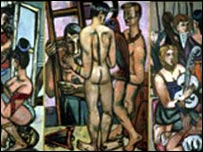 The Argonauts: Max Beckmann's final work |
"Intense" is a word often used to describe the work of Max Beckmann, a German artist who was at his peak at the beginning of the last century. Walking around Tate Modern's exhibition of his work, it seems that 14 rooms are not enough to contain all his empathy, curiosity, sadness and hope.
The strength of his feeling virtually leaps from the walls.
A figurative painter, Beckmann used the canvas to express the turmoil of his own life and the traumas of contemporary history.
A rising Berlin talent from the beginning of last century, he suffered the horrors of World War I and witnessed the rise of Nazism.
He fled to Amsterdam, after Hitler branded him a purveyor of "Degenerate Art", and eventually settled in America.
His interest in humanity is evident early in his career. His depiction of the sinking Titanic in 1912 is ambitious in its colour and scale, but it is the people in the lifeboats that draw us in.
Theatre of the absurd
The human elements - a young boy's face, a woman's breast - attest to Beckmann's concern for the beauty in everyday life, and also the precarious nature of our existence.
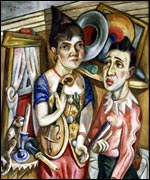 Beckmann's Carnival highlighted the absurdity of the human condition |
Beckmann's time as a wartime medical orderly inform his brutal piece, The Night. On the opposite wall is his Carnival, from a more peaceful time. But in both, the figures are distorted, almost comical, nothing is what it seems. Seen together, the artist's message is clear - the absurdity of life, and what human beings can do to each other.
There is humour on the walls. During a prosperous period before his exile, Beckmann painted Self-Portrait in Tuxedo. The cigarette-smoking, swaggering artist appears a man of confidence, but the shadow around his face keeps the work ambiguous.
Enduring curiosity
The contrast between Beckmann here and his raw, wartime despair is breathtaking. But there is a constant theme of sympathy and human warmth.
In the life boats of the Titanic and the dark of The Night, there is solidarity, even as the hope runs out.
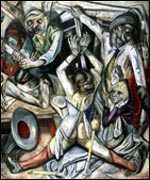 Beckmann based The Night on his wartime experiences |
And in Beckmann's very last work The Argonauts (finished the day before he died), young heroes set sail in search of the Golden Fleece. Despite everything that had gone before, Beckmann remained full of curiosity and wonder about the world around him. This exhibition is in itself a visual feast. But the knowledge of the artist's history makes us witnesses to an emotional odyssey, the path taken by Max Beckmann, still beckoning us with his brush.
The exhibition opens on Thursday 13 February at Tate Modern.


 One-Minute World News
  News services
 Email this to a friend
  Printable version