
|
 |
 | | | | | ||||||||||||||||||||||||||||||||
| | You are in: Entertainment: Film | ||||||||||||||||||||||||||||||||||
 | | Tuesday, 12 March, 2002, 09:31 GMT HG Wells: The prediction machine 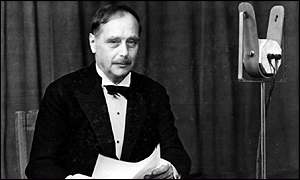 Wells lived to witness the atomic bombs he foresaw in 1914
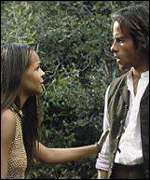
The science fiction writer and social theorist HG Wells lived long enough for his powers of prediction to be remarked on in own his lifetime. But even he might have been surprised to learn that his stories would still be recycled by Hollywood more than 50 years after his death. A film of The Time Machine, based on his 1895 book and directed by his great-grandson Simon Wells, topped box office charts in North America at the weekend. Born in 1866 in Bromley, Kent, Wells pre-dated the cinema era. But soon after the first flowering of the new medium film-makers became attracted to his work. His science fiction tale The First Men In The Moon and his humorous social study Kipps were filmed as silent movies soon after World War II. But it was in the US that the first major film was made out of Wells' work. Special effects 1933's The Invisible Man tells the story of a scientist who discovers a way to make himself invisible - then slowly goes mad with the power that his discovery brings him. Directed by Englishman James Whale, it starred Claude Rains in the title role, though a starring role was also played by the movie's special effects, which are still striking. The success of the film led to 1940's The Invisible Man Returns, starring Vincent Price in one of his earliest horror roles. In the same year as the original, Wells' warning about another crazed scientist, The Island Of Dr Moreau, was filmed in Hollywood as The Island Of Lost Souls. Charles Laughton created a memorable Dr Moreau, alongside Bela Lugosi and Richard Arlen. Epic view As if to wrest the initiative back to UK film-makers, Wells himself was heavily involved with Alexander Korda's epic view of the future, Things to Come in 1936. Like the novel, it was set during the years from 1940 to 2036 and included a lengthy world war, finishing with a prophecy of continual quest and discovery for the human race. But there was another, more domestic side to Wells' imagination, seen in Carol Reed's Kipps in 1941, which starred Michael Redgrave as the draper's assistant who rises above his social station by a miraculous bequest.
Atomic concerns Wells died in August 1946, a year after the first use of atomic weapons - a development he predicted in his 1914 novel The World Set Free. Atomic concerns were behind an audacious updating of Wells' The War Of The Worlds directed by Byron Haskins in 1953. Transplanting the Martian attack to the USA, the film chimed with Cold War concerns about a war with Russia - but, faithful to the 1898 original, the alien attack is finally defeated by bacteria, rather than any human action. The was a similarly gloomy cast to 1960's The Time Machine, directed by George Pal and starring Australian Rod Taylor as a Wells figure who travels backwards and forwards in time - accelerating through a nuclear conflagration until he finds himself in a ghastly future, 800,000 years from now. More light-hearted was the UK's First Men in the Moon a few year later, starring Lionel Jeffries as one of a pair of Victorian adventurers who reached the moon in a craft which is not entirely unlike the landing module of Apollo 11. Disaster The Island Of Dr Moreau has had two remakes in recent decades. 1977's effort, directed by Con Taylor was seen as competent, starring Burt Lancaster as Dr Moreau.
Director Richard Stanley was fired after only days of filming, and Hollywood rumours claimed Stanley sneaked onto the set in a dog-man mask to see how his successor, John Frankenheimer, was progressing. But even Frankenheimer, the director of French Connection II, could not save the film, which was branded a turkey by critics. Also panned was a 1979 remake of The Shape Of Things To Come, with Jack Palance. Nor have US critics been kind to Simon Wells's new version of The Time Machine, either - but they have not prevented the movie having a big debut, jumping straight to the top of the US box office chart. There is no sign of Hollywood interest in Wells abating. A new version of The War Of The Worlds is planned, in which the action is moved from 1890's England to early 21st century Seattle. But a release may be delayed until as far ahead as 2005 after the movie was stalled by a rethink after the 11 September attacks on the US. The extraordinary events of that day are one event that Wells does not seem to have predicted. But he did write in his Outline of History, in 1920: "Human history becomes more and more a race between education and catastrophe." | | See also:  Internet links: The BBC is not responsible for the content of external internet sites Top Film stories now:  Links to more Film stories are at the foot of the page. | ||||||||||||||||||||||||||||||||
|
Links to more Film stories |
 | | ^^ Back to top News Front Page | World | UK | UK Politics | Business | Sci/Tech | Health | Education | Entertainment | Talking Point | In Depth | AudioVideo ---------------------------------------------------------------------------------- To BBC Sport>> | To BBC Weather>> ---------------------------------------------------------------------------------- © MMIII|News Sources|Privacy  |


 E-mail this story to a friend