
|
 |
 | | | | | |||||||||||||||||||||||||||||||||||||||
| | You are in: Entertainment: Film | |||||||||||||||||||||||||||||||||||||||||
 | | Friday, 22 February, 2002, 12:18 GMT Howard defends 'distorted' film 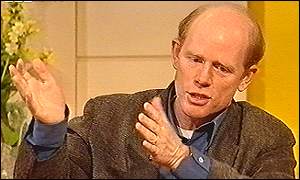 Howard: "I'm not a documentarian, I'm a story-teller." Director Ron Howard, whose film A Beautiful Mind is tipped to win a clutch of Oscars, has defended the movie's interpretation of the life of schizophrenic mathematician John Nash. Howard has been criticised of "grossly" distorting the facts of Nash's life and glossing over things that were unpalatable to Hollywood, including an "unbearable" personality, gay affairs and delusions of commuting with aliens.
"This is not a biopic. This is not a story where we're re-enacting all the details of a famous character's life," Howard told BBC's Breakfast programme. "We're using John Nash's life as a sort of springboard to illustrate something that is quite difficult, but in this case we thought was quite interesting." The main point of the film was to illustrate how someone could live with schizophrenia, Howard said, and Nash was used as an interesting example to tell a wider story.
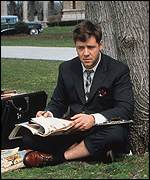
A Beautiful Mind is odds-on favourite to win the Oscar for best picture, while it has seven other nominations, including best director for Howard and best actor for its star Russell Crowe. Nash was a maths prodigy who was institutionalised after developing theories that later won him the Nobel Prize for Economics in 1994. But a film critic wrote in Friday's Daily Express that Howard's version "is taken up with characters that never existed and bizarre fantasy sequences that are in no way related to the sort of delusions Nash experienced".
"With stories inspired by a real event, you need that element of truth as a springboard. "If a story is as unusual as this one, you also need to be able to say this really did happen, it's not some sort of flight of fancy, but what you're really doing is you're looking for a dramatic theme or an idea, in this case it's illustrating mental illness." "Our big dramatic objective, quite frankly, was to try to allow the audience to understand what it might feel like to go through this experience - not to be clinical about it." 'Talent' He also said he kept Crowe and Nash apart "for a while" because he did not want the actor to feel as though he had to impersonate Nash. Howard heaped praise on Crowe's "power and range" of talent, saying he had a great deal of creative integrity and was not afraid to challenge him over things he thought were being done wrong. Howard, still known to many as teenager Ritchie Cunningham in 1970s TV hit Happy Days, also directed Splash, Parenthood, Backdraft, Apollo 13 and The Grinch. He will be at the Bafta Awards in London on Sunday, where he is nominated for best director and A Beautiful Mind is up for best film. | |
See also:  Internet links: The BBC is not responsible for the content of external internet sites Top Film stories now:  Links to more Film stories are at the foot of the page. | |||||||||||||||||||||||||||||||||||||||
|
Links to more Film stories |
 | | ^^ Back to top News Front Page | World | UK | UK Politics | Business | Sci/Tech | Health | Education | Entertainment | Talking Point | In Depth | AudioVideo ---------------------------------------------------------------------------------- To BBC Sport>> | To BBC Weather>> ---------------------------------------------------------------------------------- © MMIII|News Sources|Privacy  |




 IN DEPTH
 Academy Awards
 E-mail this story to a friend