By Tim Weber
Business editor, BBC News website, reporting from Germany |

Germany's economy, once the engine of European prosperity, is one of the eurozone's worst performers - so what are the prospects for a recovery?
Could the real German economy please step forward?
The country is the world's leading exporter, selling goods worth 733bn euro ($920bn, �500bn) a year and growing.
Profits at Germany's large companies are soaring.
Business confidence is also improving - several respected surveys suggest company bosses are getting bullish about the future.
"Perhaps we are now seeing the spark from exports firing up the economy," says Wolfgang Franz, president of the ZEW economic think tank.
And yet, after travelling through the country - listening to people, politicians and companies, and following the media - one would assume that Germany is on the blink.
It's the economy, stupid
German voters go to the polls on 18 September, and Bill Clinton's election mantra of 1992 - "It's the economy, stupid" - could have been written just for this campaign.
"More growth, more jobs" ... "Bold reforms are needed to create jobs" ... "New ideas for new jobs" - the slogans on the campaign posters are interchangeable, but one thing is constant: This campaign is focused on the state of Germany's economy like none before.
Voters are deeply cynical about the solutions on offer. With days to go to the election, more than a third of the electorate says it has yet to decide who to vote for.
Twin problems
Voters have been disappointed before. Right-wing Chancellor Helmut Kohl failed to deliver the promised "flourishing" Eastern Germany; left-wing Chancellor Gerhard Schroeder pledged in vain to cut unemployment in half.
Eastern Germany and unemployment are still the country's twin problems.
Unification 15 years ago resulted in a classic boom and bust.
Billions of Deutschmarks were spent to restore the East's infrastructure.
When the money began to run out whole industries imploded and unemployment soared.
Earlier this year, the number of jobless reached a post-war record of 5.2 million. Every day, says the opposition, another 1,000 jobs disappear.
Over the past five months unemployment rates have improved slightly, but in some regions - especially the East - unemployment is still well above 20%.
Vicious circle
Unemployment is hitting both consumers' confidence and their purchasing power.
 German shoppers are reluctant to spend |
As they tighten their belts, Germany's savings rate has reached a staggering 11%.
"Consumers think it's cool to be a scrooge these days," says Frank Brueckner, who runs a heating and plumbing business near Coburg, Bavaria.
It is a vicious circle: consumers stop spending; retailers bemoan empty shops.
In particular, weak domestic demand hurts the small and medium-sized enterprises that are the backbone of Germany's economy - its famous Mittelstand.
Many of these firms now cut jobs and invest less. With eight out of 10 employees working for Mittelstand firms, consumer confidence takes yet another plunge.
For once, the current export boom has failed to trigger a higher rate of investment, says Hans-Werner Sinn, president of the Ifo Institute for Economic Research.
All that results in poor tax receipts and - combined with eurozone stability rules - starves the federal government of money needed to kickstart the economy.
An entrepreneur's hell?
So how can the vicious circle be broken?
Some company bosses have a long list of issues they want to see tackled: the complex tax system; restrictive labour laws; rampant bureaucracy; and high social security and healthcare costs, which now make up 42% of the wage bill.
 | Seven case studies that show how German companies are beating the slump 
|
Large companies have the profit margins and legal teams to stay on top of such worries - or relocate to countries with cheap labour.
It's the Mittelstand that feels the pain.
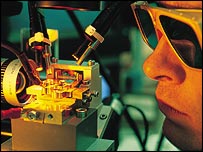
"If I hadn't been born in Germany I wouldn't invest here, because the labour laws impose so much regulation they make an entrepreneur's life hell," says Dr Ute Bergner, founder and boss of Vacom, a small firm in the East specialising in vacuum technology.
But its too early to write off Germany.
Technology-intensive firms like Dr Bergner's - and thousands like hers - are actually expanding.
Germany is moving
Over the past few years radical welfare reforms have changed the country's labour market beyond recognition.
Tales of Germany's high wages and short working hours are just that - tales.
Real wages have fallen dramatically and working hours are nearly back to 40 a week - to the point where some employers say they don't see much difference between the cost of hiring a German or British worker.
Trade unions negotiate deals with flexible hours and lower wages, tailored to the needs of companies under competitive pressure.
"I have to discuss such deals with nearly all companies in our region," says Juergen Apfel, regional organiser for the IG Metall trade union in Coburg, a depressed region in Northern Bavaria.
At the same time imports have begun to rise again, an indicator, experts say, that domestic demand is on the mend.
Foreign investors, especially hedge funds, are already busy snapping up Germany's undervalued companies and assets, hoping to capitalise on the country's potential for growth.
The risks
It will be a slow start. This year Germany's economy is expected to grow by less than 1%. Next year it might manage about 1.5%.
Should there be a recovery, it is likely to come too late for Chancellor Schroeder, who is widely expected to lose the election.
And higher oil prices, a volatile euro or a global economic slowdown could easily derail the recovery.
There are homemade threats too. The main opposition party, the CDU, wants to cut social security taxes and make up the funding shortfall by raising VAT by 2 percentage points.
That, says Julien Seetharamdoo of Capital Economics, could be as disastrous as a similar tax change in Japan in the early 1990s, which triggered a decade of low growth.
Germany's biggest problem, though, may be of its own making.
"We Germans are world class whingers," says Dr Rainer Hecker, boss of Loewe, a high-end consumer electronics firm in Bavaria.
His words are echoed by many business people. If only consumers and entrepreneurs would stop moaning and buy, invest, take risks instead.
But if it is just the gloomy mood that is holding back Germany, then the recovery could be at the mercy of some 11 men.
Next year Germany will host the football World Cup.
Should its national team do well, a consumer spending spree would be all but guaranteed.
This is the first in a series of reports from Germany; in the run-up to the election we will look at the country's unemployed, Eastern Germany, and how its companies are trying to beat the slump.


 One-Minute World News
  News services
 E-mail this to a friend
  Printable version


 At-a-glance


