 China's economy has recently had an insatiable thirst for oil |
China has raised its core interest rates for the first time in nine years, as the country's central bank moves to rein in the booming economy. The benchmark one-year lending rate is being increased to 5.58% from 5.31%, beginning on Friday.
China, the world's seventh biggest economy, has grown so quickly in recent years that it has caused energy and steel shortages
The rate rise follows other cooling measures such as curbs on bank lending.
Limits on investment spending have also already been introduced.
Widely supported
These earlier measures appear to have had some effect - China's third-quarter 2004 gross domestic product (GDP) growth was 9.1%, down from 9.6% in the second, and 9.8% in the first.
However, the Beijing government decided that further action was needed. Inflation remains a threat - consumer prices rose 5.2% in the year to September, just off a seven-year high of 5.3% seen in July and August.
"It (the interest rate adjustment) is to maintain the momentum of continuous, fast, coordinated and healthy economic growth," said the People's Bank of China, adding that it took the move only after approval from the Chinese cabinet.
Analysts broadly welcomed the move.
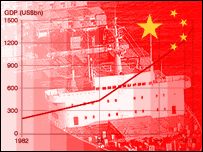
How open trade has transformed China's economy since the 1980s 
|
"It's about time, because we needed to see higher interest rates to help curb investment," said Ben Simpfendorfer, an economist with JP Morgan in Hong Kong. Audrey Childe-Freeman, economist at Canadian Imperial Bank of Commerce, said the rate increase "reduces the long term risk of an economic recession in China and, more broadly, the world economy".
Julian Jessop, chief international economist at UK-based Capital Economics, said the move was "more remarkable for the impact it has had on global financial markets than for what it says about China".
He said commodity markets had fallen in the belief that the rate rise made a so-called hard landing more likely, but that the reaction had been "overdone".
"Given the Chinese authorities' preference for gradualism in economic policy, further small rate rises are on the cards," he said.
"But in an economy where the volume of credit matters much more than the price, this is essentially a sideshow."


 One-Minute World News
  News services

 E-mail this to a friend
  Printable version
  It's about time, because we needed to see higher interest rates to help curb investment
 In graphics