By Steve Schifferes
BBC News Online economics reporter |

 More funds for the UK security services |
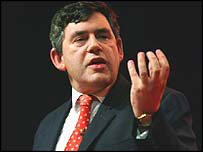
Gordon Brown has made it clear that the government is determined fully to fund the fight against terrorism, as he came under fire from the Tories for having a secret agenda to raise taxes, following last week's Budget. Mr Brown told the House of Commons Treasury Select Committee that he was cracking down on terrorist finance, with the bank accounts of five Hamas members frozen, including those of its new leader in Gaza, Abdel Aziz al-Rantissi.
The Treasury said the action was taken because they had reasonable grounds for suspecting that he and Musa Abu Marzouk, Imad Khalil Al-Alami, Usama Hamdan and Khaled Meshal "are, or may be, persons who facilitate or participate in the commission of acts of terrorism".
The chancellor also called for Europe to do more to act together against those who fund terrorists.
Mr Brown said that he would spend "whatever is necessary" to fight terrorism, and that spending on the security services had been increased by 50%.
Economic hopes
Mr Brown was closely questioned about the state of the UK economy, which he has forecast to grow by 3-3.5% this year and next.
He said that he expected the economy to "rebalance", with growing manufacturing exports and increased public investment boosting output as the consumer boom and the house price boom slows. But he denied that there would be a "hard landing" in the housing market, despite warnings from the International Monetary Fund.
Mr Brown said that most commentators had been wrong when they said the economy would not grow strongly in the past year.
The Chancellor praised the role of the Bank of England in preventing the UK economy going into recession.
"We have been through a world downturn that has been extremely severe...I believe that the action by the Bank of England that was early and decisive...was extremely important," he said.
Conservative MPs criticised measures introduced in the budget to change the rules on transfer pricing for large companies, claiming it would put them at a competitive disadvantage compared to their European rivals.
A guide to the ups and downs of the UK economy 
|
But their main line of attack was their claim that Mr Brown had a hidden agenda to raise taxes after the next General Election to close the growing Budget gap.
Tax rises
In his Budget last week, Mr Brown admitted that he was facing a �37bn budget deficit this year, but said he would meet his own fiscal rules without having to raise taxes.
Many independent economists, as well as his political opponents, have warned that current measures will not bridge the budget shortfall in future years.
But the chancellor said that "fiscal drag" - the fact that as people earn more they move into higher rate tax bands - would continue to boost government revenues.
It was the fact that "more people are in work and more people are earning more" that was boosting tax revenues, he said.
Conservative MP Michael Fallon challenged Mr Brown to state explicitly whether he would raise taxes, and Mr Brown refused to do so.
"Every commitment we made last week is fully affordable and fully financed," Mr Brown said.
But "there are circumstances that any Chancellor has to take into account," he added.
 | DEBT PREDICTIONS 2003/04: �37bn (up �10bn) 2004/05: �33bn (up �9bn) 2005/06: �31bn (up �8bn) 2006/7: �27bn (up �5bn) Figures show Mr Brown's current predictions compared with his forecasts in April 2003 |
The Institute for Fiscal Studies, and many other independent forecasters, still think Mr Brown is being too optimistic about how much additional revenue the government can raise without tax increases to reduce the Budget gap to prudent levels.
They project a �13bn gap by the beginning of Mr Brown's next economic cycle starting in 2005-6.
The IFS points out that if the Treasury is correct, then Mr Brown can afford his spending plans - and then the Tories can also afford their tax cuts.
That might explain why neither side was keen to question Mr Brown's budget forecasts in the hearing.


 One-Minute World News
  News services
 E-mail this to a friend
  Printable version
 At-a-glance
 Speech in full


 Tax and credits guide
